
Your Deep Cycle Lead Acid Battery Is Not Worn Out — It Is Sulfated
A deep cycle lead acid battery for solar rarely dies of old age. It dies of partial state of charge — the charge it never quite finished. What sulfation does, the four ways a site starves its own bank, and the numbers that decide year eight.
The bank that dies at eighteen months
The installer blames the battery. The battery supplier blames the charger. The site owner blames both and buys lithium.
Almost every failed deep cycle lead acid battery for solar that we look at died the same way, and it usually has nothing to do with manufacturing quality. The cells were never allowed to finish a charge. Day after day the array put back 85 or 90 % of what the load took out, the plates sat in partial state of charge, and a slow chemical change did the rest.
This is the least discussed number in solar storage, and it explains more premature failures than any other single factor.
The datasheet number that never survives contact with a roof
A deep cycle lead acid battery for solar is usually sold on a cycle count: 500 cycles at 50 % depth of discharge, sometimes 600, occasionally more. Those numbers come from a bench test that does three things the field never does.
It holds the cells at 25 °C. It returns them to a full charge after every single discharge. And it uses a charge profile set by someone who knows what absorption voltage means.
A real installation breaks all three. Ambient temperature swings from 0 °C at night to 35 °C in the cabinet at noon. The load grows by a third when the owner adds a freezer. And the controller is a small MPPT with a fixed absorption timer that starts counting from the moment it wakes up, not from the moment the battery actually reaches absorption voltage.
The same battery, in the same jar, cycling at 70 % state of charge for two years, will not see 500 cycles. It will see something closer to 200, and it will lose capacity gradually enough that nobody notices until the fridge starts cutting out at 3 a.m.
What partial state of charge actually does to the plates
In a deep cycle lead acid battery for solar, discharging forms lead sulfate on both plates. That is normal and reversible — it is how the battery stores energy. Recharge converts it back to lead, lead dioxide and sulfuric acid.
Leave that sulfate sitting there and it recrystallises. The crystals grow larger and denser, surface area collapses, and the material becomes progressively harder to convert back. This is hard sulfation, and at the point where you can measure it, no amount of equalisation charging will recover the lost capacity. You can slow it. You cannot undo it.
Three signatures show up on a deep cycle lead acid battery for solar long before the owner admits there is a problem:
- Resting voltage looks fine, load voltage does not. 12.6 V after an hour of rest, then 11.4 V the moment a 30 A load lands. High internal resistance from sulfated plates.
- Cell voltages spread under charge. A healthy string converges within 0.05 V per 12 V block during absorption. A sulfated string can drift 0.3 V or more, and the weakest block drives the whole string.
- Charge current never tapers. A healthy VRLA at absorption drops to around 0.01–0.02 C within a couple of hours. If the charger is still pushing near full current after four hours, either the bank is deeply discharged or part of it is not accepting charge at all.
Four ways a solar site starves its own bank
The array is sized for the load, not for the recharge. A common design error: 3 kW of panels against a deep cycle lead acid battery for solar sized at 10 kWh for a 4 kWh nightly load. On paper the array covers the load twice over. In December, with two cloudy days and a 60 % derate, it covers the load and nothing else. The bank never gets above 80 %, and it never gets there fast enough.
Absorption time is set by a timer, not by the battery. Two hours of absorption sounds generous until you realise the controller started the clock at sunrise. Bulk phase ends at 11:00, absorption runs to 13:00, and by then a cloud has passed and the current has dropped below the point where the battery is actually gassing and mixing electrolyte. The battery thinks it is full. Its specific gravity says otherwise.
No temperature compensation. A deep cycle lead acid battery for solar charged at 2.45 V/cell in a 35 °C cabinet is being overcharged, which drives water loss and grid corrosion. The same setting at 0 °C is undercharging, which is exactly the condition that grows hard sulfate. The correction is roughly −3 mV per °C per cell, and plenty of small controllers simply do not apply it.
Mixing ages in one string. Adding a new block to a three-year-old deep cycle lead acid battery for solar is the fastest way to kill the new block. The old blocks reach absorption voltage first, the charger backs off, and the new block never gets the extra charge it needs to catch up. It sulfates while sitting next to blocks that are already sulfated.
AGM, GEL and lead-carbon in the same deep cycle lead acid battery for solar site
| AGM deep cycle | Tubular GEL | Lead-carbon | |
|---|---|---|---|
| PSOC tolerance | Low | Moderate | High |
| Cycle life at 50 % DoD (typical) | 400–600 | 800–1,200 | 1,500–3,000+ |
| Charge acceptance | Good | Fair | Very good |
| Cost vs AGM | Baseline | +25–40 % | +10–20 % |
| Best fit | Shallow daily cycling, standby | Deep cycling, hot climates, long life | Solar and wind where full recharge is unreliable |
Those cycle numbers are planning figures from manufacturers and vary with depth of discharge, temperature and how faithfully the bank is recharged. Treat them as a ranking, not a promise.
What lead-carbon actually changes, and what it does not
For a deep cycle lead acid battery for solar that rarely finishes a charge, lead-carbon puts carbon additives into the negative plate. The carbon raises charge acceptance and changes the crystal structure of the sulfate that forms, so the plate recovers more readily when the battery finally does get a full charge. In practical terms the battery tolerates PSOC cycling that would halve the life of an AGM.
What it does not do is remove the need for a full recharge. A lead-carbon deep cycle lead acid battery for solar that never sees absorption voltage still sulfates; it just does so more slowly. It also does not change the temperature compensation requirement, and it does not make a 50 % depth of discharge into 80 %.
The premium is usually quoted at 10–20 % over an equivalent AGM, which pays back quickly in a site that cycles daily and recharges badly — and never pays back in a site that already has a generous array and a proper charge profile.
The settings that decide whether a deep cycle lead acid battery for solar lasts
These are the settings worth arguing about with the installer, because they matter more than the brand on the lid:
- Charge factor 1.10–1.20. Amp-hours returned divided by amp-hours taken out, measured over a week, not a day. Below 1.10 the bank drifts downward permanently.
- Absorption voltage at 25 °C. Around 2.40–2.45 V per cell for cyclic AGM (14.4–14.7 V per 12 V block), 2.35–2.40 V per cell for GEL. Float around 2.25–2.27 V per cell.
- Absorption termination by current, not by clock. End absorption when current falls to about 0.01–0.02 C, or hold a minimum of two to three hours, whichever is longer.
- Temperature compensation at roughly −3 mV/°C/cell, sensing at the battery, not in the controller cabinet.
- A full recharge at least weekly, even if it means running a generator for two hours in a bad week. This single habit is worth more than upgrading the battery.
- Depth of discharge at or below 50 %, with an occasional deeper cycle doing less harm than a permanent 20 % shortfall in recharge.
What to write into the purchase order
- For a deep cycle lead acid battery for solar, cycle life quoted against IEC 61427-1, the standard written for renewable-energy storage, rather than a generic cycling standard.
- The depth of discharge, temperature and end-of-life capacity criterion attached to that cycle count.
- Initial capacity and the tolerance at the 10-hour rate, not just the 20-hour rate.
- The recommended absorption, float and equalisation voltages at 25 °C, plus the temperature compensation slope.
- Whether the product is rated for PSOC cycling, and if so under what test.
- Cell matching data — open-circuit voltage and internal resistance per block at shipment.
- The warranty terms on depth of discharge and on water loss, in plain language.
One site, two winters, two outcomes
A hilltop repeater in a hot, dry region ran eight 12 V 200 Ah AGM blocks as its deep cycle lead acid battery for solar bank. Winter one ended with the string at 71 % of rated capacity. The controller's absorption timer was 90 minutes and the array was 20 % undersized for December. The fix was cheap: 1.2 kW more panel, absorption extended to 3 hours with current-based termination, and a weekly full charge. Winter two lost 3 %. Same battery model. Same installer.
Questions buyers actually ask
Can I recover a sulfated battery with an equalisation charge?
Sometimes, if the sulfate is still soft. A 2–4 hour equalisation at the manufacturer's voltage can recover part of the capacity on a flooded or GEL bank that has been undercharged for weeks. Once the crystals have hardened, you are wasting electricity. Measure capacity before and after; if nothing changed, stop.
Is 50 % depth of discharge a real limit or a marketing number?
It is a real trade-off rather than a cliff. Cycling to 70 % does not destroy the battery in a week, but it consumes cycle life faster than the arithmetic suggests, because the last 20 % of discharge is where stratification and plate stress concentrate.
Does a bigger deep cycle lead acid battery for solar fix a PSOC problem?
No. A bigger bank at the same recharge current sits at a lower state of charge for longer, which is worse. Fix the charge first, then size the bank.
Are sealed batteries worse than flooded for solar?
Not inherently, but they give you fewer options. You cannot check specific gravity, you cannot add water, and you cannot equalise aggressively. That is why the charge profile has to be right from day one.
The part that never makes it into the quote
Nobody sells a deep cycle lead acid battery for solar on the strength of its charging profile, because a charging profile is not a number you can put on a comparison sheet. It is also the thing that decides whether the bank reaches year eight or gets replaced in year two.
If you are specifying a deep cycle lead acid battery for solar or moving a site from AGM to lead-carbon, ask the supplier what charge factor their cycle-life claim assumes. A supplier who answers in amp-hours has tested the product in the field. A supplier who answers in adjectives has not.
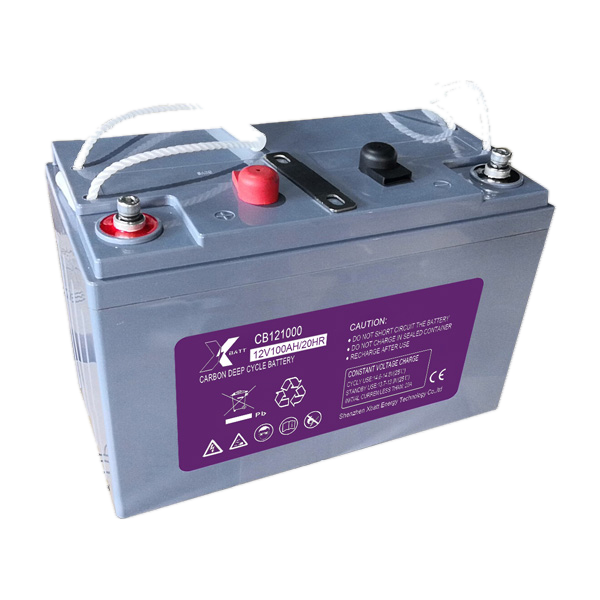
XBATT publishes absorption, float and equalisation voltages per model, which is the minimum you should expect — the lead-carbon range is specified for PSOC cycling, and the buying guide for energy-storage lead-acid covers how to check a jar before it goes into a string.
Looking for a reliable battery supplier?
Send us your requirements — model, quantity and target market. Quote within 24 hours.
Get a Quote