
Lead Is Flat. Your 2027 Quote Isn't.
Two containers, two prices, one flat chart. The metal did not get dearer — the premium, the assay and the plate thickness did, and none of them show up on the LME screen.
The chart is flat and the quote went up
Say you book a container of 12 V 200 Ah AGM in September and again in November. You pull up the LME lead chart, and it is a straight line — cash settled at $1,853 a tonne on 13 November, $1,825 on the 20th. Basically the same metal. Then the new quote comes back three or four percent higher than the old one, and you sit there wondering which of you is being played.
Neither, probably. The exchange price and the price you actually pay stopped tracking each other closely this year, and that gap has a name: the physical premium. It is the part nobody puts on a website, the part that gets negotiated in a WhatsApp thread at 11 pm, and right now it is doing more work than the LME number ever does.
Two prices for one metal
The LME lead contract is a lowest-common-denominator product. It allows a minimum of 99.97 % purity and a fairly wide band on bismuth. Battery plants are fussier. Bismuth and antimony content changes how the grid casts, how the alloy ages, and how much gassing you get at the end of charge — so a smelter selling to a battery factory is selling something the exchange does not quote.
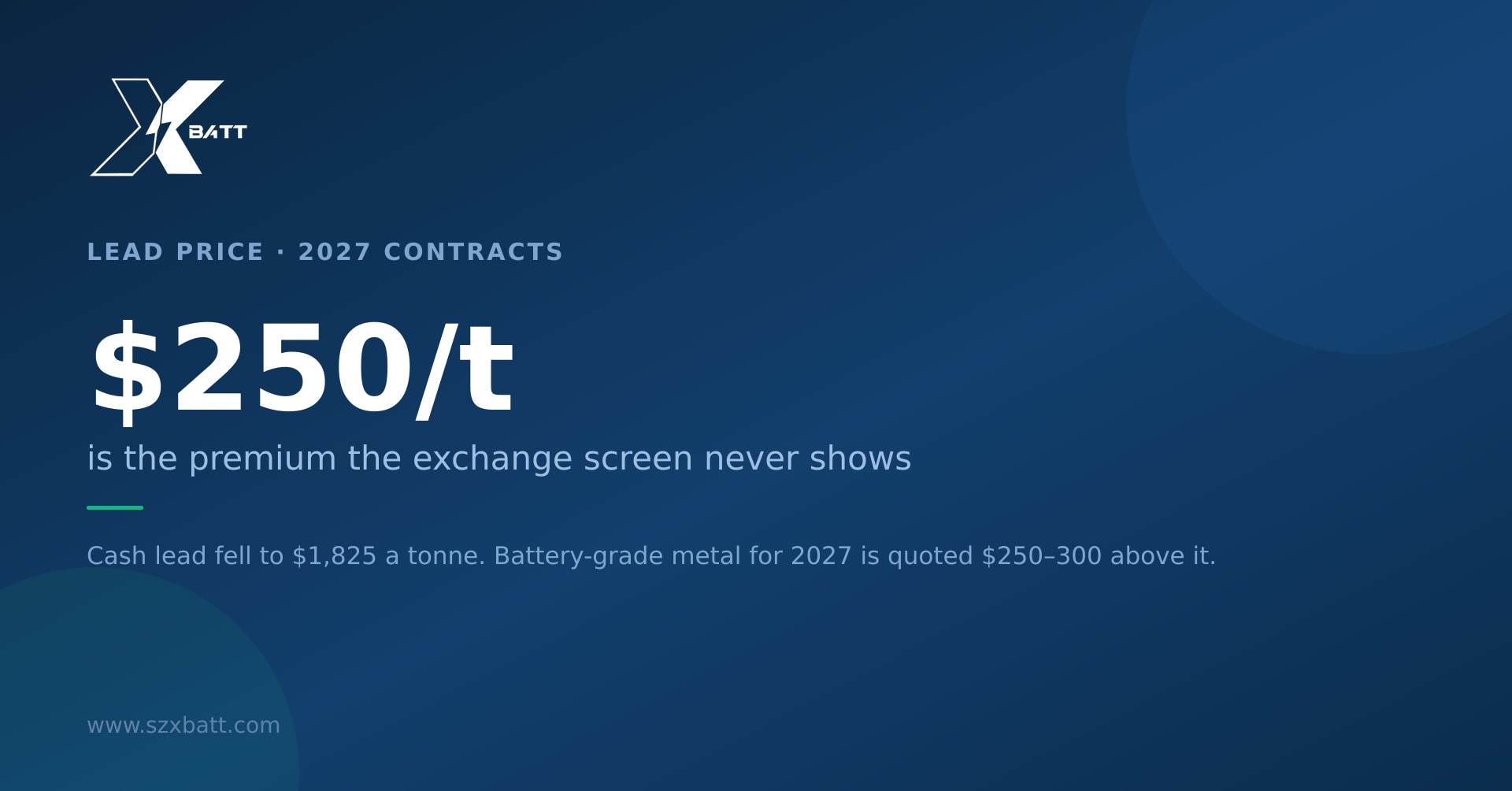
That difference has a price. Through the second half of this year, sellers in Southeast Asia have been offering 2027 supply of 99.99 % lead at premiums of roughly $250 to $300 a tonne over LME. For 2026, plenty of buyers locked in something in the low $100s. Same metal family, two different markets.
So: 170,000 tonnes came out of LME warehouses between mid-July and November, and the price still slid 1.5 % in the week to 20 November. Stocks fell, price fell, and the premium rose. If you only watch one of those three numbers, you are reading a third of the story.
| What moved | 13 Nov 2026 | 20 Nov 2026 |
|---|---|---|
| LME cash lead | $1,853/t | $1,825/t |
| LME 3-month | $1,886/t | $1,861/t |
| LME stocks | 283,350 t | 261,525 t |
| Cash-to-3M spread | $33 contango | $36 contango |
| Battery-grade premium, SE Asia, 2027 | — | ~$250–300/t |
Why the headline number is stuck
Three things are pressing down on the exchange price at once. Stocks are still large in absolute terms — 261,525 tonnes is a lot of metal sitting in a warehouse. The curve is in contango, meaning nobody is scrambling for metal today; if they were, cash would trade above three-month. And Chinese demand is soft enough that the lead-acid battery operating rate across five provinces came in at 69.13 % for 6–12 November, down 0.85 points week on week.
Underneath that, the International Lead and Zinc Study Group expects refined production of 13.88 million tonnes this year against 13.79 million tonnes of use — a surplus of about 90,000 tonnes, widening to roughly 163,000 tonnes in 2027. On paper, that is a buyer's market for years.
And yet. Mine output is forecast down 2.8 % to 4.44 million tonnes in 2026, treatment charges for concentrate are deeply negative, which is economist for "smelters are paying to get fed", and China's refined lead consumption is forecast to grow just 0.2 %. A surplus built on weak demand is not the same as a surplus built on abundance. It can disappear the moment someone restocks.
What your $/Ah is really made of
Here is the part worth internalising before your next negotiation. Lead is maybe a third to a half of what a battery costs. The rest is plate thickness, alloy, grid design, acid, separators, labour, energy, freight, duty, and the paperwork that lets a container clear customs.
Two factories can quote the same 200 Ah block and be selling you two different products. One uses 3.2 mm plates, calcium-tin alloy, and a decent separator. Another shaves the plate to 2.6 mm and buys the cheapest grid alloy it can cast. On the datasheet they look identical. On year four, in a hot cabinet, they are not. I wrote about why plate geometry decides cycle life in tubular versus flat plate, and it is the same logic here: you are not buying amp-hours, you are buying a wear rate.
This is also why a sudden 5 % drop in a quote deserves more suspicion than a 5 % rise. Metal did not get cheaper overnight. Something in the bill of materials did.
The scrap side moved too
One more variable that barely makes the trade press: India banned exports of specified unsorted battery waste and scrap from 10 November 2026, black mass included, under DGFT Notification 49/2026-27. India has 57 registered recyclers with about 517,000 tonnes a year of processing capacity and only around 75,500 tonnes of it geared to black mass. Keep that feedstock at home and the international scrap flow tightens, which eventually shows up in secondary lead availability and in the price of the recycled fraction.
For a battery buyer this is second-order today. In 2028 it might not be.
What to put in the 2027 RFQ
If the price you pay is LME plus a premium, then negotiate the premium separately, in writing, with a defined assay. Concretely:
- Specify purity and bismuth, not just "battery grade". 99.99 % with bismuth under a stated ppm is a different purchase order from 99.97 %.
- Name the alloy. Calcium-tin, calcium-tin-silver, antimonial — they behave differently in float service and in cycling, and they cost differently.
- Pin the plate thickness in millimetres, in the spec sheet, with a tolerance. It is the single easiest thing to shave.
- Write the price mechanism as a formula: LME monthly average + fixed premium + exchange rate band + freight. If a supplier will not show you the formula, you are negotiating a number, not a price.
- Fix the delivery window. A 2027 premium is only worth signing if the tonnes actually land in Q1 rather than "after the holiday".
- Ask for the assay certificate per lot. If the answer is "our lead is always good", that is your answer.
If you are still choosing between factories, these six checks before wiring a deposit are a faster filter than any price comparison.
Waiting for a dip is a strategy with a cost
Every year someone decides to hold off until lead "comes back down". Sometimes it works. But look at the curve: metal for delivery in three months costs more than metal today. The market is literally charging you $36 a tonne to wait — and that is before the premium moves, before freight moves, and before the tax treatment of your export changes. On the Chinese side the rebate structure has already been reset once; I went through what that did to landed cost in this piece on the export rebate cut.
Buyers who did well this year were not the ones who predicted the LME. They were the ones who knew what was in the box, had a formula instead of a favour, and bought the specification rather than the number on the front of the datasheet.
The metal is boring. The paperwork around it is where the money is. Which is annoying, because the paperwork is also the part nobody wants to read on a Friday afternoon.
Sources
BigMint. "LME lead declines 1.5% w-o-w despite 6.4% inventory drawdown." BigMint, 20 Nov. 2026, bigmint.co.
Kalkine. "Why Lead Buyers Face Rising Premiums Despite 283,350 Tonnes in LME Warehouses." Kalkine, 13 Nov. 2026, kalkine.co.uk.
SteelMint. "LME: Lead prices remain stable as 7% inventory decline offsets weak battery demand." SteelMint, 13 Nov. 2026, steelmint.in.
Looking for a reliable battery supplier?
Send us your requirements — model, quantity and target market. Quote within 24 hours.
Get a Quote