
Your Camper Doesn't Need a Bigger Battery. It Needs a Load Table.
Same story every trip: the fridge wins by Thursday and everyone blames the battery. Nine times out of ten the size was fine and the charging never finished.
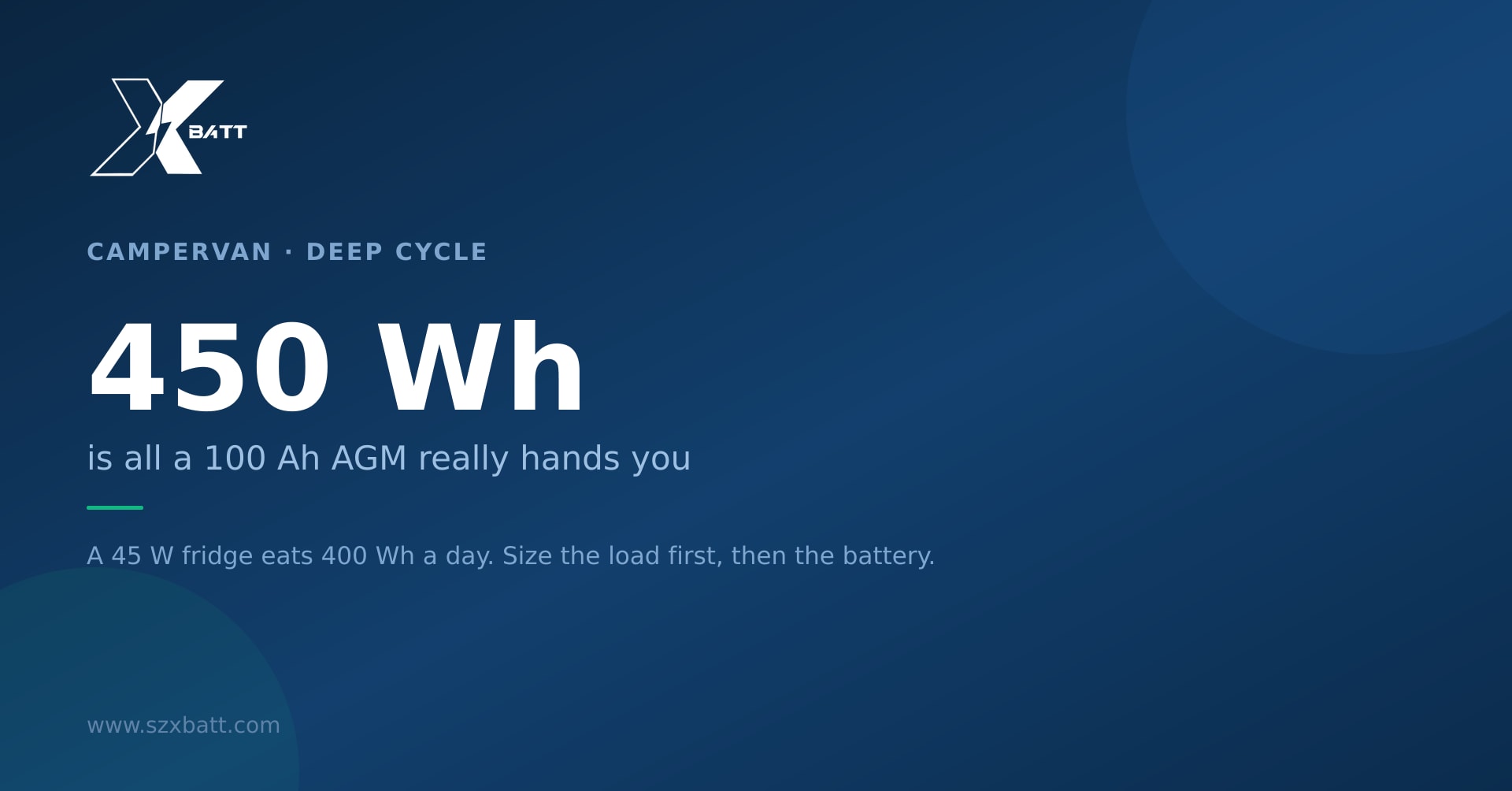
The fridge wins every argument
Picture a hired camper on the second morning of a trip. The coffee is on, the kids are still asleep, and the shunt says 61 % — at nine in the morning, with the sun barely over the trees. By evening the inverter is beeping and someone is asking, very reasonably, whether the battery is broken.
It isn't. The battery was sized by a conversation that went "how many amp-hours do you want?" instead of "what runs, for how long, and how do you put the energy back?" Those are different questions, and only the second one has an answer that survives a cloudy Tuesday.
So let's do it properly, with a fridge, because the fridge is the whole argument.
Add up the load before you look at any battery
A 12 V compressor fridge rated at 45 W does not draw 45 W all day. It cycles — roughly a third of the time in mild weather, closer to half when the van is 30 °C inside. Call it 350–450 Wh a day. That single appliance is usually bigger than everything else combined, which is why the first question is not "how big is my battery" but "how big is my fridge and how hot is my van".
| Load | Watts | Hours/day at full draw | Wh/day |
|---|---|---|---|
| Compressor fridge 45 W | 45 | ~8 (35 % duty) | 360 |
| Diesel heater, running | 25 | 6 | 150 |
| Laptop + charger | 60 | 3 | 180 |
| LED lighting | 8 | 4 | 32 |
| Water pump | 60 | 0.2 | 12 |
| Two phones, one tablet | 15 | 3 | 45 |
| Typical couple, spring/autumn | ~780 |
Add 10–15 % for the inverter if you run anything on 230 V, and 10 % again for wiring and age. Round it up: 900 Wh a day is a fair working number for two people living in a van without trying to save power. In summer with the fridge working harder and a fan running, budget 1.1 kWh. In a ski resort in February, the heater eats the fridge's share and you land in the same place.
What 100 Ah actually hands you
This is where most sizing goes wrong. A 100 Ah AGM at 12 V holds 1.2 kWh of nominal energy, and you may use about half of it before cycle life starts falling off a cliff. That is 600 Wh on paper. After Peukert — the fact that a battery delivers less total energy at higher currents than at low ones — and after inverter losses, you are realistically working with 450 to 500 Wh.
Meaning: one 100 Ah AGM runs the fridge for about a day. Not two. When someone tells you their 100 Ah setup "lasts three days", ask what the fridge is and whether they unplug it at night.
A 100 Ah LiFePO4 is a different arithmetic. About 90 % is usable, voltage holds flat under load, and Peukert barely applies, so you get roughly 1.0–1.1 kWh out of the same label. Twice the usable energy, 12 kg instead of 30, and four to eight times the cycles. It costs about twice as much up front. Per usable kilowatt-hour, it is closer than the sticker suggests.
Charging is the half everyone skips
You can size a battery perfectly and still be flat by Thursday, because the energy has to come back in. Three sources, three very different realities:
- The alternator, through a split-charge relay. Your van's alternator regulates at about 13.8–14.2 V at the terminal. An AGM wants 14.4–14.7 V in absorption. Over six metres of 16 mm² cable at 30 A you lose another half a volt. Net result: the battery sits at 13.2 V for two hours, reaches maybe 70–80 %, and never gets a finishing charge. Do that every day for a season and you have a sulfated battery that tests fine at rest and dies under load.
- A DC-DC charger. This is the fix, not an upgrade. A 30 A unit takes whatever the alternator gives, boosts it to a proper absorption voltage, and holds it. Roughly 350–400 Wh per hour of driving, so two hours of driving covers a day's consumption.
- Solar. A 200 W panel, four peak-sun-hours, 75 % real-world derate: about 600 Wh a day in summer. In northern Europe in December, with the sun at 15°, that same panel gives you 150–250 Wh. Winter solar is a trickle, not a plan.
Put those together and the rule of thumb is unglamorous: you need about 1.5 days of consumption in usable storage, and a way to put back a day's worth in a day. Below that, every cloudy spell becomes an emergency.
Three vans, three honest specs
Weekend van, two people, no inverter. 100 Ah AGM, 100 W solar, 20 A DC-DC. Enough for Friday-to-Sunday with the fridge on, provided you drive home. This is the cheapest sane setup and it works — nobody on a two-night trip needs 400 Ah.
Full-time couple, one of them working from the van. 200 Ah LiFePO4, 400 W solar, 30 A DC-DC, 2,000 W inverter. That gives about 2.1 kWh usable, which covers 900 Wh a day with a full day of margin and absorbs two grey days without drama. This is the setup most people should actually buy if the van is a home.
Winter ski van. Cold changes the rules twice: the fridge works less, the heater works more, and lithium will not accept charge below 0 °C. Either buy a heated LiFePO4 pack with a BMS that blocks charging under zero, or accept two 100 Ah AGMs and the weight. I went through the cold-charging numbers in LiFePO4 in cold weather, and the short version is that a pack which refuses to charge is protecting itself, not failing.
AGM or lithium, decided by how you use it
If the van does 40 nights a year and always comes home to a hookup, AGM is fine and the money is better spent on a DC-DC charger. If the van is lived in, cycles every day, and never sees a full charge from a wall socket, lithium pays for itself in about three years — and saves you the 18 kg.
Two things people get wrong either way. Lead-acid, including AGM, still wants ventilation if it lives inside the living space; it is not "sealed" in the way the marketing implies, and a hot cupboard with a charging battery is not where you want to store bedding. And lithium wants to be above freezing to charge but is perfectly happy to sit at -10 °C and discharge, so "lithium doesn't work in winter" is only half true.
If you are still choosing chemistry for a boat or a camper, this comparison of GEL and flooded on the water covers the failure modes that actually happen, which are rarely the ones in the brochure.
A number is not a budget
The honest way to size this is a table, like the one above, with your own loads and your own climate. Ten minutes with a notebook beats any online calculator, because the calculator cannot know that you boil a kettle twice a day or that your fridge sits in direct sun.
And when the table is done, check the number against reality: a 900 Wh daily draw with 1.5 days of usable storage and 600 Wh a day of charging means you are one bad weather front away from a decision. If that sounds uncomfortable, the answer is not a bigger battery — it is a bigger panel or a shorter shower. I wrote about the same trap in battery bank sizing, and it applies to a camper exactly as it does to a house.
The camper in the story at the top did not need a new battery. It needed 200 more watts on the roof and a charger that finishes the job. Both cost less than the battery they were about to buy, and neither one beeps at dinner.
Looking for a reliable battery supplier?
Send us your requirements — model, quantity and target market. Quote within 24 hours.
Get a Quote