
One Bad Jar in a Lead-Acid String: Why We Replace the Whole String
One jar dies in a 48 V lead-acid string — can you swap just that one? This is lead-acid only: the series-current rule, how cell reversal turns a cheap fix into an accident, how resistance mismatch eats your runtime, and the narrow case where a single-jar swap is defensible.
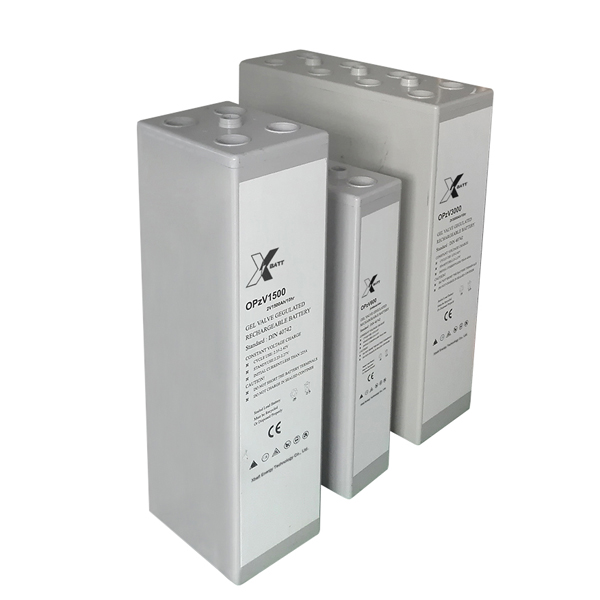
One jar swells up. The other twenty-three look fine. So someone asks: can we just swap that one?
Last month a data centre customer sent us a photo. Three rows of 2 V cells, 24 of them, wired into a 48 V OPzV string. The jar on the far left had clearly swollen — the ribs on both sides of the case were pushed out. The question he asked is one we hear several times a month: can we replace just that one?
Honestly, our first answer used to be yes. It is what the customer wants to hear, it costs a fraction of a full string, and throwing away twenty-three jars that still hold a charge does feel wasteful. Then we started tracking what happened six and twelve months later. It went badly often enough that we changed our answer.
This piece is lead-acid only — flooded OPzS, gel OPzV, and the AGM blocks that fill most equipment rooms. Lithium plays by a completely different set of rules. That is another article.
What a series string actually guarantees
Every jar in a series string carries exactly the same current. That one fact drives everything else, and it is the reason "replace only the broken part" works everywhere else in electrical work and fails here:
- The usable capacity of the string equals the capacity of its weakest jar. Drop a 100% jar into a string whose remaining jars sit at 70% and you do not get 100%. You still get 70%.
- The charger protects on string voltage, not on the condition of individual jars. A string floating at a perfectly respectable 54.0 V can contain one jar being cooked and one jar starving at the same time.
- Internal resistances add up, and the highest one decides how much of your runtime gets converted into heat and voltage sag.
Nothing inside a lead-acid string inspects the jars one by one. Nobody is looking after the individual units. They live or they die together.
What happens in each of the four stages after the new jar goes in
| Stage | The new jar | The aged jars | Net result |
|---|---|---|---|
| Charge | Still short of full when the charger leaves boost | Fill first, then keep absorbing current → gassing, water loss, grid corrosion | Sulphation on the new one, dry-out on the old ones |
| Float | Held below the voltage it actually needs | Held above it, permanently overcharged | Accelerated corrosion; thermal runaway risk in VRLA |
| Discharge | Still has reserve | Empty first, then dragged below 0 V | Reversal, internal heating, venting |
| Rest | Slow self-discharge | Faster self-discharge | The gap widens every single week |
Read that table twice. The trap is in the second row. At 25 °C a VRLA jar normally floats at 2.25–2.30 V per cell and equalises at 2.35–2.40 V per cell, with temperature compensation of −3 mV/°C per cell on top. The charger works to the average of 24 jars — it cannot tell which one is new. The new jar has the lowest internal resistance, so it lands closest to the lower end of the voltage band and sits undercharged; the aged jars, with higher resistance and a lower gassing threshold, drift towards the top. The brand-new jar you just paid for is being slowly ruined by the string around it.
Cell reversal — the step that turns a cheap repair into an incident
Same string of 24: the 23 old jars have 70% of nominal capacity left, the new one is at 105%. On discharge the 23 old jars empty first. The load does not stop, because the string voltage is still above the inverter cut-off. So current keeps flowing — backwards, forced through jars that have nothing left to give.
For the jar being reversed:
- Its terminal voltage goes negative, typically somewhere between −0.5 V and −2 V per jar under load;
- Plate polarity effectively inverts, the side that should be positive starts evolving hydrogen, the electrolyte boils locally, and pressure inside the sealed case climbs;
- The case swells, the vent opens, and acid mist comes out with it. In a closed battery cabinet, add one small spark nearby and you have a flammable atmosphere.
We have watched a single reversed jar take out an entire cabinet — not by fire, but by the acid that sprayed out after venting and ate the cabinet and the tray below it. That bill is a lot bigger than a new string.
Resistance mismatch quietly eats your runtime
A fresh VRLA jar measures roughly 3–4 mΩ internally; by end of life it has crept up to 8–10 mΩ. In a string discharging at 100 A, that difference alone adds 0.5–0.7 V of extra sag, which means:
- The inverter low-voltage disconnect trips early — a nominal 10 minutes of autonomy becomes 6;
- That extra drop turns into heat in whichever jar has the highest resistance, so the hot spot always lands on the oldest one;
- On charge, a large part of the terminal voltage is IR drop rather than state of charge, so the charger is making decisions on a number that no longer means what it thinks it means.
This is the part people hate hearing: after swapping in a brand-new jar, the string's runtime is often shorter than it was with the dead jar still in it. You spent money and made it worse.
Those other twenty-three jars are not as healthy as you think
This is the point that gets missed most often. One string of lead-acid jars has spent five years under the same float voltage, in the same room, through the same grid events — so they age together:
- Positive grid corrosion is progressive and irreversible; it is the classic end-of-life mode for lead-acid;
- Active material softens and sheds a little more on every deep cycle, and what falls off settles at the bottom as sediment;
- Jars that sat undercharged or ran hot have grown hard, coarse lead-sulphate crystals that no amount of charging brings back;
- A VRLA jar loses water slowly and continuously, and no oxygen recombination efficiency recovers what has already gone out through the valve.
The rule of thumb across the industry is simple: once measured capacity falls below 80% of rated, schedule the replacement. IEEE 450 says this for flooded cells and IEEE 1188 says it for VRLA. So when the first jar finally collapses, the rest usually test out somewhere just above 80%. They are not "good jars you can keep" — they are jars queueing up to be the next one down. Replace the first and a few months later the second one lies down in exactly the same spot.
So when is a single-jar swap acceptable?
We are not going to pretend it never is. A one-jar swap is defensible only when all of the following hold:
| Check | Acceptable range |
|---|---|
| Age of the string | < 12 months |
| Capacity of the remaining jars | ≥ 90% of rated |
| Internal resistance of the remaining jars | Within 10% of factory value |
| Cause of failure | A clear external cause — single manufacturing defect, physical damage, burnt connection — not ageing |
| Old vs new batch | Same model, same capacity, same batch; cross-batch requires measured matching |
| After the swap | Equalise charge within 24 h, re-test capacity and resistance within 30 days |
In practice, when a string under a year old loses one jar, it is usually a manufacturing defect — and that goes through warranty, where the manufacturer will normally ask for a whole-string assessment anyway. For the requests that really matter, the ones sitting in the three-to-five-year bracket, the answer is almost always: replace the string.
How to spec the new string so the money is not wasted
- Replace the whole string with one model, one capacity, one batch. No mixing manufacturers, no mixing batches, no mixing old with new.
- Measure open-circuit voltage and internal resistance on arrival, and keep the string matched within ±5% on capacity and ±10% on resistance — again, the IEEE 450 logic.
- Run one full capacity test after installation and keep the record. That is your baseline for every annual test from now on.
- Re-test at 30 days to confirm nothing has fallen behind.
- While you are in there, check connector torque, the temperature probe, and the charger's float voltage and temperature compensation. Ageing is never only the battery's own fault.
Do the arithmetic
| Option | Up-front cost | Chance of a second failure within 6 months | What it really costs you |
|---|---|---|---|
| Replace only the dead jar | 4% of a string | High | Repeat labour + outage risk + collateral damage |
| Replace the whole string | 100% | Low | Done in one visit, life starts counting again |
| Replace the string + proper matching and acceptance | 104% | Very low | Least trouble, and the easiest one to justify upwards |
Four percent looks very tempting. The thing is, that 4% does not buy "fixed". It buys "holds for now". And an outage never tells you in advance which day it is coming.
What we actually do
- Test the whole string before ordering anything — log open-circuit voltage, resistance and physical condition jar by jar
- Decide whether the failure is ageing or an external cause, using service time and history
- Any string already sitting near 80% capacity gets replaced as a string, no single-jar patching
- Match the new string on arrival: ±5% capacity, ±10% resistance, one batch
- Run a full capacity test and keep it as the baseline, then re-test within 30 days
- Calibrate float voltage and temperature compensation at the same time, so the new jars do not walk the same road as the old ones
At the end of the day a battery string is a team sport. Swap out one player and the team does not get stronger — it keeps running at the pace of its weakest member. Next time somebody asks "can we just change the one that failed?", we hope you already know the answer.
Looking for a reliable battery supplier?
Send us your requirements — model, quantity and target market. Quote within 24 hours.
Get a Quote