
How to Tell If a Storage Lead-Acid Battery (Gel / AGM) Is Brand New or Refurbished
Refurbished second-life batteries are often polished, washed and re-labeled until the case looks factory-fresh. The case alone tells you nothing — what really gives them away is the terminals, laser code, internal resistance, capacity and traceable sourcing with a contract warranty.
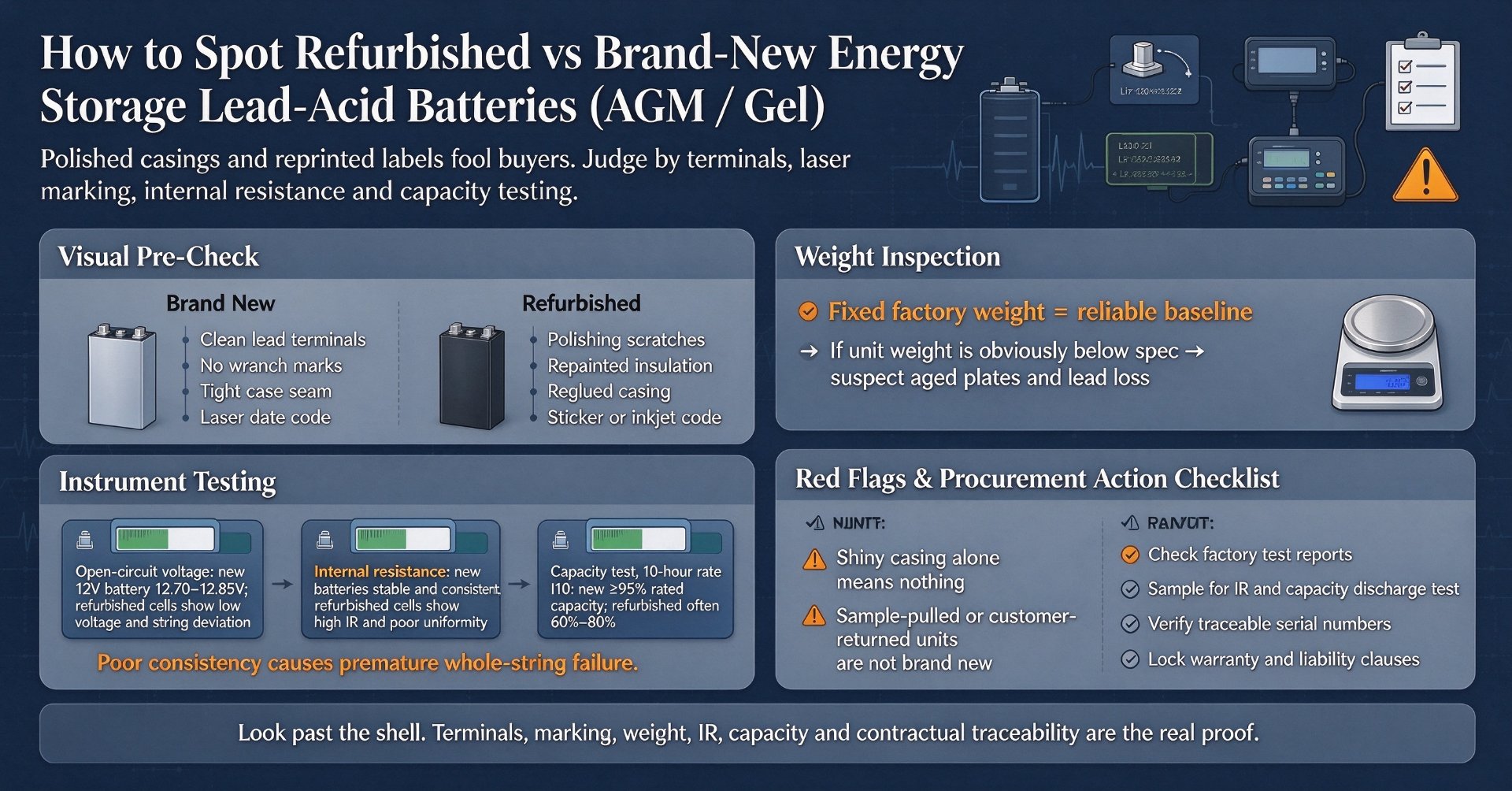
Not long ago we were putting together a storage bank for an overseas client. They shipped over a batch of "brand-new" gel batteries — the cases gleamed, the labels were crisp, honestly they looked newer than the stock sitting in our own warehouse. Then we put them on the resistance tester. The voltage spread across the bank was absurd, and the discharge capacity barely hit seventy percent of rated. Classic refurbished second-life goods.
That was the moment it really sank in: with storage lead-acid — gel or AGM storage types — judging new versus old by the case is basically guessing blind. The most common refurbishing trick is exactly this: grind, wash, polish the terminals, slap on a new label, and the case ends up looking almost as good as off the line. So here I have broken it down: where the fakes always slip, and which instruments expose them on the spot.
1. Visual inspection (eyes only — the first filter)
Terminals — where the flaws hide ⭐ top priority
✅ New: lead posts are bright; the bolt holes show no wrench marks, no compression, no grind or polish traces; no green or white oxidation powder; no solder residue at the base; red and black pole paint is even, factory-sprayed.
❌ Refurbished: even after polishing, a close look shows fine grind scratches; bolt holes carry compression marks from being wrenched; some get repainted, and the paint is uneven and flakes off easily.
Case and seams
✅ New: virgin housing material, even gloss; top and body seams are tight, no overflow glue, no re-bonding marks; no frosted grind or polish marks on the surface.
❌ Refurbished: the case was pried open for repair then glued shut, so seams show overflow adhesive; local sanding leaves the shell hazy, and under strong light you can see the old markings that were sanded away.
Laser code / manufacturing date / serial number
✅ New: laser-etched or stamped, the text is permanent and will not rub off with alcohol; prefer units made within 3 to 6 months; stock older than 12 months is not worth buying.
❌ Refurbished: labels stuck on later, or codes printed with ink afterward and easy to wipe away; old dates ground off and re-stamped, with uneven character depth.
2. Weighing (simple and effective)
For the same model of storage lead-acid (say 12V100AH or 12V200AH), the factory weight is fixed — note the standard weight beforehand. If a single unit is clearly lighter than the rated weight, the plates have most likely aged and lost lead, which means it is a refurbished second-life unit.
3. Instrument testing (bulk acceptance for export — the core; test even if the case looks new)
For a storage bank purchase, testing each cell's internal resistance plus open-circuit voltage plus capacity discharge is the gold standard for telling new from old.
Open-circuit resting voltage (rest 24h+, at 25℃)
- New, fully charged 12V storage lead-acid resting voltage: 12.70 to 12.85V
- Used old battery: even fully charged and rested, the voltage runs low, with high scatter, and clear voltage differences within the bank
Internal resistance (battery resistance meter)
- New of the same model: resistance sits in a stable range
- Used: resistance is clearly higher, and the spread across the bank is large; second-life cells have very poor resistance consistency
Capacity discharge test (I10, the 10-hour rate — the storage industry standard)
✅ New: measured capacity at or above 95% of rated
❌ Refurbished: often only 60% to 80% of rated; no matter how new the case looks, the capacity has faded, so in a real storage project it sags fast and dies young
Key point: cell-to-cell consistency
In a series storage bank, mixing new and old will kill the whole bank early.
4. Common tricks to watch for
- Old storage batteries washed, polished, terminals buffed, labels swapped — the case looks almost brand new. This is a very common refurbishing move in the export market.
- Stock new batteries are not refurbished: a stock unit still has a fresh case, but after long storage it self-discharges and needs pre-charging and matching before use. That is not the same as a second-life cell — separate them with resistance plus capacity.
- When a seller says "sample pulled from equipment" or "customer-returned good unit," that is really a turnover battery and must not be purchased as new.
At the end of the day, buying storage lead-acid, do not let a gleaming case fool you. The terminals, the laser code, the internal resistance, the capacity — plus a traceable source and a contract warranty you can actually enforce — that is what is reliable. Ever since, when we match banks for clients we insist on the factory report plus a resistance and capacity spot-check. We would rather spend half a day inspecting than watch a project flatline after six months. Next time you source, throw this checklist at your supplier — whether they dare to be tested already tells you plenty.
Looking for a reliable battery supplier?
Send us your requirements — model, quantity and target market. Quote within 24 hours.
Get a Quote