
How to Properly Maintain Your Batteries? Our Engineers Break Down the Manual, All the Essentials in One Read
Buying GEL / AGM lead-acid energy storage batteries is easy — long-term care is what truly matters. Our engineers laid out the full lead-acid battery maintenance workflow: incoming inspection, storage environment, charging specs, preventing over-discharge, plus a standardized periodic maintenance checklist.
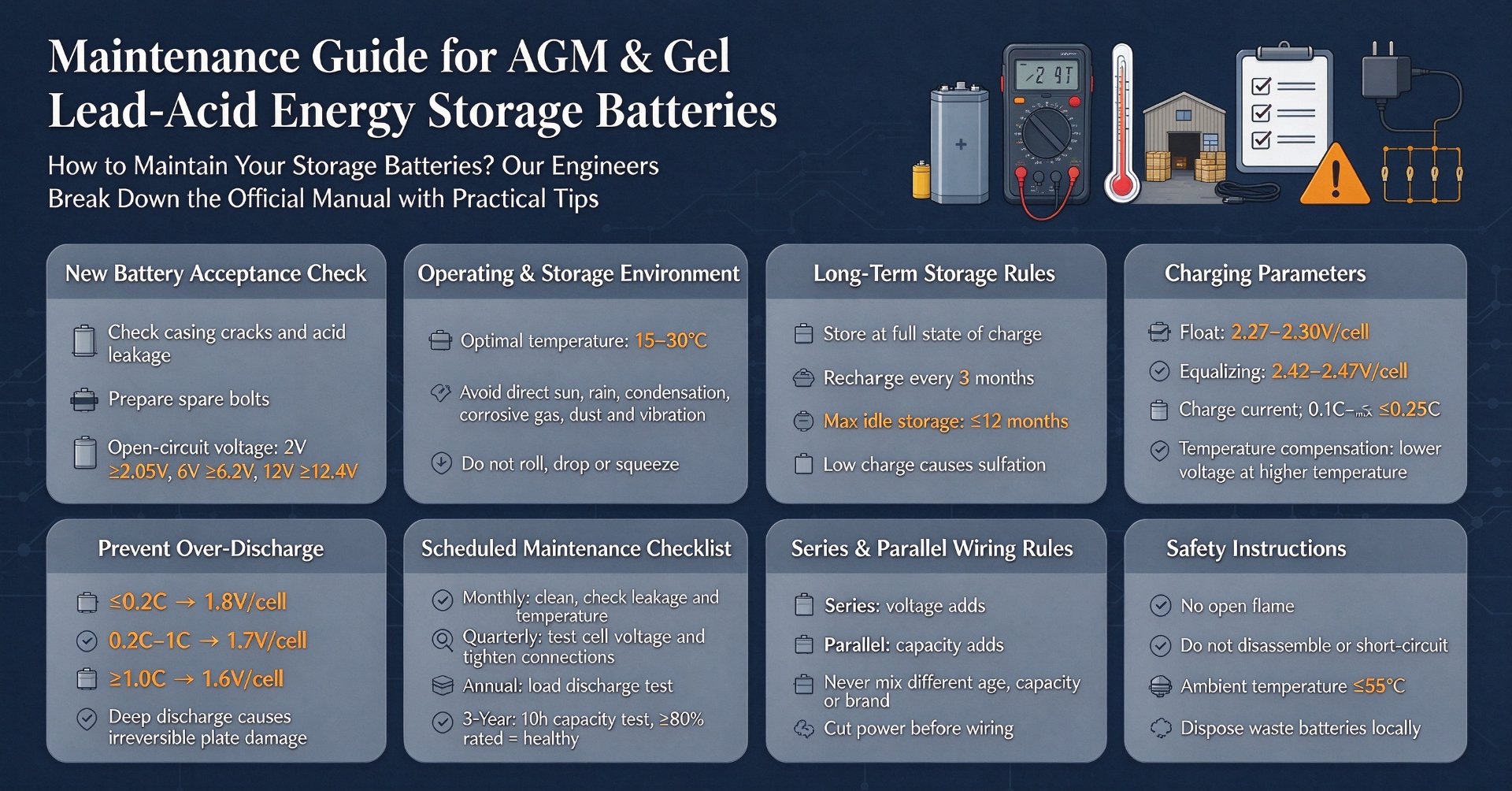
Buying GEL / AGM lead-acid energy storage batteries is easy — long-term care is what truly matters. Our engineers laid out the complete lead-acid battery maintenance workflow: incoming inspection of new batteries, storage environment, charging specifications, strict prevention of over-discharge, plus a standardized periodic maintenance checklist.
Many customers run into the same problem: a new battery performs well right after installation, then within half a year its capacity drops sharply. After years in this industry, we've learned that for energy storage lead-acid (GEL / AGM) batteries, the product itself accounts for about 30%, and daily use and maintenance for the other 70%. A battery doesn't fail instantly — it's usually long-term misuse that slowly wears down the plates until it fails early.
Let's set aside the dry manual text and organize the core points of energy storage battery maintenance.
New batteries on arrival: do not install and use directly
Incoming inspection is the first gate, and many hidden risks get overlooked here. Check three things:
- For batteries above 24AH, make sure there are enough matching bolts — we recommend two sets per battery, to avoid running short on fittings during later wiring;
- Inspect the case thoroughly for cracks and acid leakage;
- Use a multimeter to measure the open-circuit voltage of each cell, to catch fake-charged units early: 2V cell ≥2.05V, 6V battery ≥6.2V, 12V battery ≥12.4V is acceptable.
We've seen a customer put batteries straight onto the rack on arrival, with a hidden leak that took down the whole string within three months. Never skip incoming inspection.
Battery storage environment requirements
AGM and GEL storage batteries are environment-sensitive. Ideal: 15–30℃, and a temperature-controlled room is best kept at a stable 25℃.
These environments accelerate aging and, in severe cases, cause leakage, electric leakage, and safety hazards:
- Ambient below -10℃ or above 50℃
- Outdoor exposure to rain or direct sunlight
- Condensation or ice formation
- Corrosive gases present
- High humidity or heavy dust buildup
- Continuous vibration or frequent impact
Handling note: batteries are heavy and the case is brittle — no rolling, throwing, or heavy stacking pressure; protect the terminals. We've seen stacked cargo crush battery terminals and deform them on site.
Long-term idle storage: must be stored fully charged
For long idle periods, never store in a discharged state — sitting discharged causes plate sulfation and permanent capacity loss.
Storage environment 15–30℃; top up the charge every 3 months; maximum storage period no more than 12 months, beyond which both capacity and service life drop noticeably.
Charging specs: float to maintain, equalize to restore (25℃ baseline, AGM & GEL storage batteries)
- Float charge (daily online standby)
Cell voltage: 2.27–2.30V; 2V series cells 2.26–2.28V; max float current 0.25C; for every 1℃ rise, reduce charging voltage by 3mV.
- Equalizing charge (capacity recovery)
Cell voltage 2.42–2.47V; temperature compensation: for every 1℃ rise, reduce voltage by 5mV.
Charging procedure: use 0.1C–0.15C constant current, max charging current not exceeding 0.25C; once the set voltage is reached, switch to constant-voltage charging until the charging current drops to 0.006C and holds steady for 3 hours — that means the battery is full.
When to start an equalizing charge
- Float online voltage below 2.20V / cell
- After a new battery completes its commissioning trial run
- Discharge depth exceeds 30% of capacity
- Battery has been idle for close to 3 months
- Continuous float operation has run a full 3 months
Over-discharge is the #1 hidden killer of energy storage lead-acid batteries
The discharge cut-off voltage varies with discharge current (C = rated capacity). You must stop discharging once the cut-off is reached; deeper discharge causes irreversible plate damage that charging cannot recover:
- Discharge current ≤0.2C: cut-off 1.8V / cell
- 0.2C < current < 1C: cut-off 1.7V / cell
- Current ≥1.0C: cut-off 1.6V / cell
Standardized periodic maintenance schedule
Maintenance isn't guesswork — execute by cycle:
✅ Monthly inspection
Clean surface dust, wipe terminals; check case deformation, terminal corrosion, acid leakage; record ambient temperature, case temperature, terminal temperature; measure total string voltage.
✅ Quarterly inspection
Complete all monthly items; measure each cell's float voltage; check connection tightness, tighten if loose; perform a 24-hour equalizing charge.
✅ Annual maintenance
Complete quarterly items; the safety valve must not be removed — confirm it is tightened; perform a loaded discharge test, releasing 30%~40% of rated capacity for performance verification.
✅ At 3 years
Run a 10-hour rate capacity test; measured capacity ≥80% of rated capacity means the battery is healthy.
Series/parallel wiring: no mixing old/new or different brands
Series: voltages add, capacity unchanged — must use same-capacity batteries;
Parallel: capacities add, voltage unchanged — must use same-voltage batteries.
❌ Strictly forbidden: mixing different capacities, mixing old and new, or combining different brands in series/parallel. Many customers mix batteries just to save trouble, and typically the whole string goes unbalanced within half a year.
Wiring rules: cut power before working; tighten joints to prevent arcing; clean oxidized terminals with a baking-soda solution; keep tools insulated, and never place metal tools above the batteries to avoid short circuits.
Hard safety rules
No open flame, no disassembling the battery; battery ambient temperature must not exceed 50℃, and burning batteries is strictly forbidden; do not repair batteries yourself; never short the positive and negative terminals; recycle spent batteries compliantly, never discard casually.
Energy storage GEL / AGM batteries, with simple regular inspections, will greatly extend their service life; waiting until they completely fail to remedy costs far more. If you use XBATT energy storage lead-acid batteries, follow this maintenance plan to avoid the vast majority of faults. For parameters or faults you're unsure about, feel free to contact our technical service team anytime.
Looking for a reliable battery supplier?
Send us your requirements — model, quantity and target market. Quote within 24 hours.
Get a Quote