
C10 vs C20: Why the Same Battery Has Two Capacities
Two suppliers can both quote 100Ah and ship batteries of different size. The C-number decides what you actually get. How to compare quotes fairly, and what to put in the RFQ.
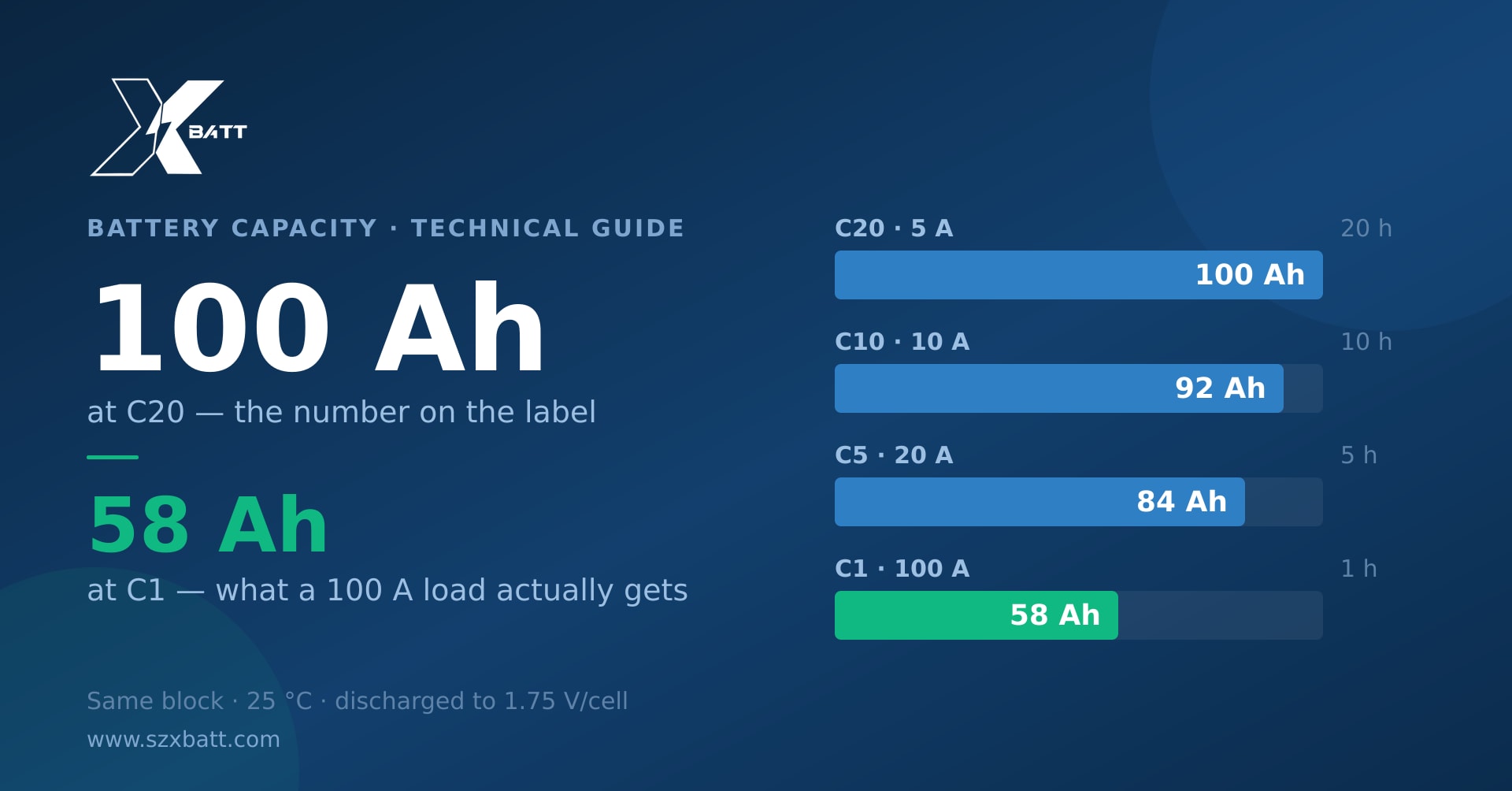
A 100Ah battery is not 100 ampere-hours at every discharge rate.
Put the same block on a 5A load and it gives you 100Ah. Pull 100A out of it and you get closer to 58Ah. Nothing changed inside the case — only the speed at which you emptied it.
This is why two suppliers can both quote "100Ah" and ship you batteries of different physical size. The number is meaningless until you know which rate it was measured at.
What the C number means
The C-number is the discharge period the capacity was measured over.
C20 means the battery was discharged steadily over 20 hours until it hit the cut-off voltage. For a 100Ah C20 block that is a 5A load for 20 hours.
C10 is the same test over 10 hours, so a 10A load. C5 is 20A for 5 hours.
Two conditions are always attached to the figure, and they are usually printed in small type:
- End voltage. Stationary VRLA is normally taken to 1.75 V/cell; telecom standards often use 1.80 V/cell. Stopping earlier gives a smaller number.
- Temperature. Capacity is referenced to 25°C. Below that, usable capacity falls by roughly 1% per °C.
Why capacity drops when current rises
Three things happen at once.
The electrolyte inside the plate cannot resupply acid fast enough at high current, so the voltage collapses before the active material is fully used. Internal resistance eats a larger share of the terminal voltage. And the relationship is not linear — Peukert described it as I^n × t = constant, with n around 1.1 to 1.25 for AGM and slightly higher for flooded cells.
The practical result: the faster you discharge, the less you get.
The same block at four rates
Typical figures for a 12V VRLA AGM block rated 100Ah at C20, discharged to 1.75 V/cell at 25°C. Illustrative, not a specification:
| Rating | Load | Time to cut-off | Delivered capacity |
|---|---|---|---|
| C20 | 5 A | 20 h | 100 Ah |
| C10 | 10 A | 10 h | ~92 Ah |
| C5 | 20 A | 5 h | ~84 Ah |
| C1 | 100 A | 1 h | ~58 Ah |
Same battery. A 42% spread between the top and bottom line.
Where each rating is used
- Telecom and stationary standby is quoted at C10, usually to 1.80 V/cell. A "100Ah" telecom block is therefore a physically larger battery than a "100Ah" C20 solar block.
- Solar and off-grid is quoted at C20, sometimes C100 for very small loads, because the average discharge is slow.
- UPS does not use Ah at all. It is quoted in watts per cell for a fixed runtime — commonly 15 minutes down to 1.67 V/cell — because the load is a short, violent discharge.
- Automotive uses CCA and reserve capacity, which are different measurements again.
The quote trap
Supplier A offers 100Ah at C20. Supplier B offers 100Ah at C10. B's battery is roughly 8–10% larger and heavier, and it will cost more. On price per Ah, A looks cheaper. On price per delivered ampere-hour in the application, the ranking can flip.
Add the end-voltage difference and you have another 3–5%. Add a 10°C site temperature and you lose another 10%. Three small print items, and the "cheapest" quote is the most expensive system.
If you want to see how this plays out on real hardware, the XC series AGM range lists both the C20 rating and the watt-per-cell figures for each model, and the instruction manual gives the discharge tables by end voltage.
Five checks before you compare price
- Same C-rate. C20 against C10 is not a comparison.
- Same end voltage. 1.75 V/cell against 1.80 V/cell moves the number by several percent.
- Same temperature basis. Claims measured at 25°C do not hold at 0°C.
- Ah or W/cell. For UPS duty, ask for watts per cell at your target runtime.
- Rated or typical. Ask for the test report, and check the serial or date code against it.
What to put in your RFQ
One short paragraph saves a week of email:
Capacity required at C10 and at C20, end voltage, ambient temperature range, expected load profile and backup time, and the application (telecom, solar, UPS, traction).
A supplier who cannot answer in those terms is quoting a catalogue number, not a battery.
One note on lithium
LiFePO4 behaves differently. Capacity barely moves between 0.2C and 1C — a few percent, not forty — so the C-rate trap is much smaller. The equivalent trap is depth of discharge and usable kWh, which is covered in this comparison of 100Ah lithium capacity and DoD.
FAQ
Is a battery rated at C10 better than one rated at C20?
No. It is the same chemistry measured on a different stopwatch. What matters is whether the rating matches your discharge profile.
Can I use a C20-rated battery in an application specified at C10?
It will deliver less than the nameplate suggests. Size up by 10–15% and confirm the end voltage your inverter or rectifier actually cuts off at.
Why did my 100Ah battery test at 85Ah?
Check the test rate, the end voltage, the electrolyte temperature and the age of the block, in that order. A capacity test run at the wrong rate is the most common reason for a false failure.
Products used for this job
The series our engineers would quote for this application.
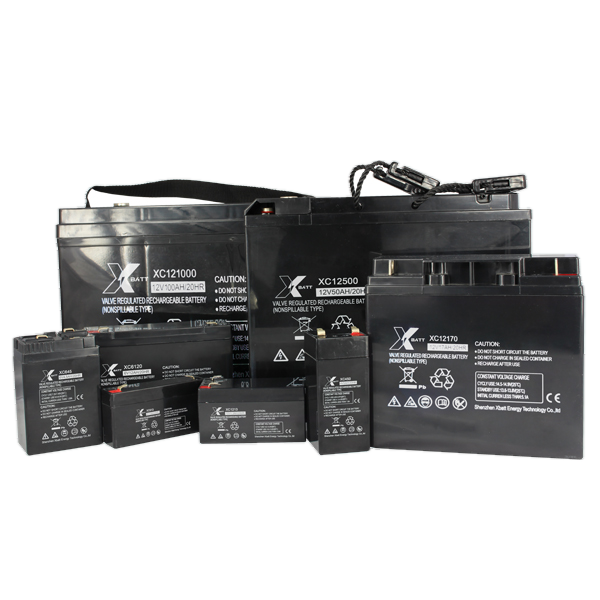 XC Series AGM BatteryGeneral purpose maintenance-free VRLA, 5–10 years service life
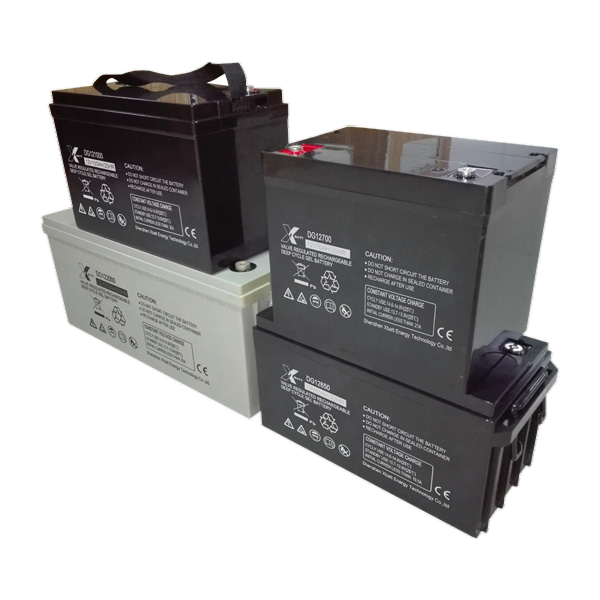 DG Series GEL Battery15-year floating life, 400+ cycles @100% DOD in extreme climates
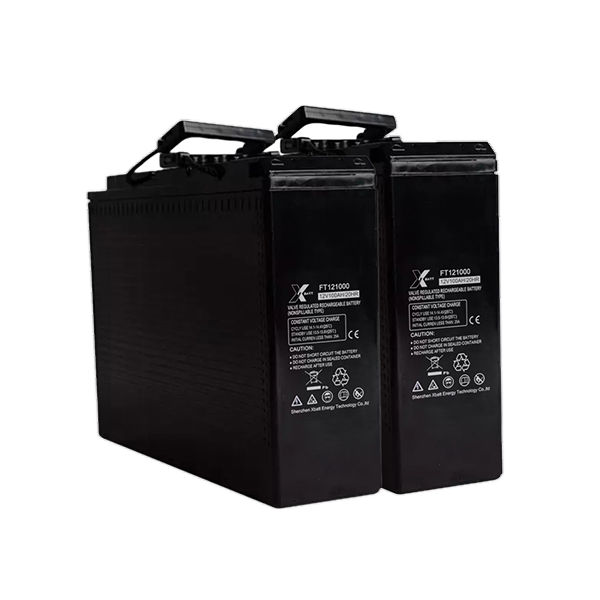 FT Series Front-Terminal Battery19-inch rack mounting for telecom & broadband
Looking for a reliable battery supplier?
Send us your requirements — model, quantity and target market. Quote within 24 hours.
Get a Quote