
Winter Storage: Cold Doesn't Kill a Lead-Acid Battery
Every January someone sends a photo of a battery that came out of a shed at 4.1 V and says the cold killed it. It didn't. The cold is the accomplice — state of charge is the crime.
The one that died in a shed
Every January the same message turns up. A 12 V 200 Ah AGM spent the winter in an unheated shed, and in April it reads 4.1 V. The smart charger flashes a fault and refuses to touch it. The owner says the cold killed it.
The cold didn't. A healthy, fully charged lead-acid battery will sit out a winter in a shed that drops to -25 °C and come back in spring with a couple of percent less charge than it went in with. What killed that one is that it went into November half empty and then sat there for five months.
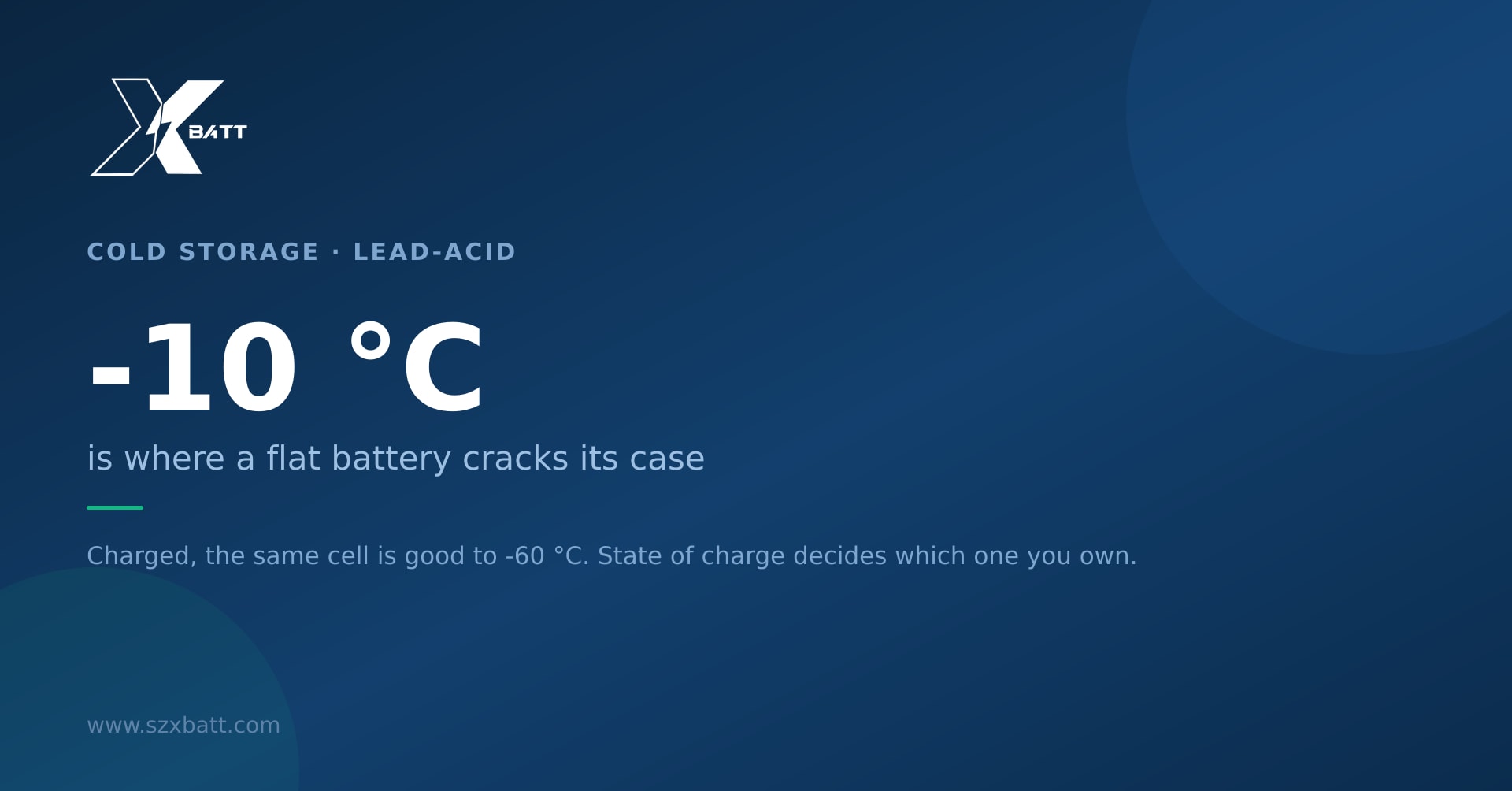
Two things happened in that shed, and neither of them is "cold damage". The electrolyte went from acid-strong to nearly water, which lifted its freezing point from about -60 °C to somewhere near -10 °C. Then one night in January it froze, the water inside expanded by roughly a tenth of its volume, and that was the end of it. Cracked case, buckled plates, active material shaken off the grids. No charger brings that back.
So keep the two ideas apart: cold you can live with, empty is a slow execution.
What cold really does to the numbers
At -18 °C a lead-acid battery delivers roughly 40–50 % of its C20 rating. At 0 °C it is nearer 70–85 %. That sounds like a disaster until you notice it is reversible: warm the battery up and the capacity walks back. Nothing was destroyed, the reaction just got slower.
Internal resistance is the other half of the story. It roughly doubles by -20 °C, which is why a pack that sits happily at 13.1 V in July sags to 9 V under load in January and everybody decides the battery is finished.
On a standby string this matters less than the forums suggest. A 48 V telecom bank at -10 °C holds its float voltage perfectly well; it simply has less in reserve than the commissioning sheet promised. The real risk in that cabinet is not the cold, it is a rectifier with a fixed float setting that is quietly undercharging the string every night. That is a separate problem, and there is a link to it further down.
Freezing is a state-of-charge question, not a temperature one
| State of charge | Specific gravity | Electrolyte freezes at |
|---|---|---|
| 100 % | 1.265 | about -60 °C |
| 75 % | 1.225 | about -40 °C |
| 50 % | 1.190 | about -25 °C |
| 25 % | 1.155 | about -15 °C |
| flat | 1.12 | about -10 °C |
Treat those as a band rather than a spec — makers publish slightly different numbers, and a GEL cell is not identical to a flooded one. The shape of the curve is what matters.
Read it this way: at full charge you own a battery that will shrug off an Arctic night. At a quarter charge you own one that cracks the first time the shed drops below -15 °C. Same battery. Different November.
What to do before the season turns
- Charge it full, then leave it. For a 12 V block that means about 12.7 V at rest after a few hours off the charger, or 1.265 SG on a flooded cell. "Nearly full" is the same as empty over five months.
- Break the circuit. A disconnected battery self-discharges at maybe 3–5 % a month at 25 °C, and slower when it is cold. A connected one also feeds the clock, the radio memory or the inverter's standby draw, which is a different and much faster drain.
- Cold is your friend, as long as the battery is full. Self-discharge slows down as temperature drops. A cold, dry, ventilated shed in good condition beats a warm garage with a damp floor.
- Check it every couple of months. Twelve-point-something volts is fine. Below 12.4 V, put it back on charge for a day. This one habit is the difference between a battery and a doorstop.
- Ignore the concrete myth. Modern polypropylene cases do not leak charge into a concrete floor. Damp and dirt on the top of the case do, because a wet film of acid residue conducts. Wipe the lid, keep it dry.
- Never charge a frozen battery. Let it come up to room temperature first. Charging ice drives gas into a blocked cell and can split the case.
AGM and GEL need a different kind of care
You cannot top up a VRLA cell, so the failure mode is not "ran dry" but "dried out from overcharging". That makes the storage voltage more important, not less: a charger left connected all winter at a fixed 13.8 V in a cold shed will undercharge, and the same charger in a warm room will slowly cook the electrolyte away.
Store them charged, disconnected, and out of the sun. If they are going back into a solar or telecom duty afterwards, have a look at the AGM and GEL maintenance checklist — the storage habits and the in-service habits overlap more than people expect.
If the pack is LiFePO4, the rule changes
A lithium pack does not sulfate and does not freeze into a brick, but it has a harder limit: it must not be charged below 0 °C. A good BMS blocks charging at that point, which is exactly why a campervan that sits through a cold snap can wake up with a pack that will discharge but refuses to take charge. I went through the numbers on that in LiFePO4 in cold weather, so I will not repeat them here.
The storage advice is otherwise similar: charge to roughly 50–60 %, disconnect, and do not leave it plugged in for months at a time.
Spring: charge it before you judge it
Put it on a low-current charge for a full day before you test anything. A lightly sulfated battery often comes back most of the way; a heavily sulfated one charges quickly, reads 13 V, and collapses the moment you put a load on it. If a capacity test comes back below 80 % of rating, replace it — and if it lives in a string, replace the whole string rather than mixing a new block with old ones, for the reasons in this piece on string replacement.
The battery in the shed did not die of cold. It died of an October decision nobody thought about. This year, make it a different one — a full charge, a disconnected terminal, and a note on the calendar for February.
Looking for a reliable battery supplier?
Send us your requirements — model, quantity and target market. Quote within 24 hours.
Get a Quote