
The Cell Price Is Near the Floor. Your Order Should Not Wait for It.
A distributor in Poland wanted to hold off until March. His screenshot was convincing: lithium down 60 % since May. Then I priced what waiting actually costs.
"Should we wait until March?"
A distributor in Poland asked me that on Monday, and he had a screenshot to justify it: lithium carbonate down 60 % since May, cells down with it, and his customer — a small C&I installer — refusing to sign anything until Q1.
I understand the instinct. If an input fell 60 % in six months, the safe move looks like waiting. But I have watched this exact trade for a few years now, and waiting has a price that does not show up on the price chart. So let me put the numbers on the table and then tell you what I would actually do.
What the price did this year
The swing was violent in both directions, which is why everyone is confused.
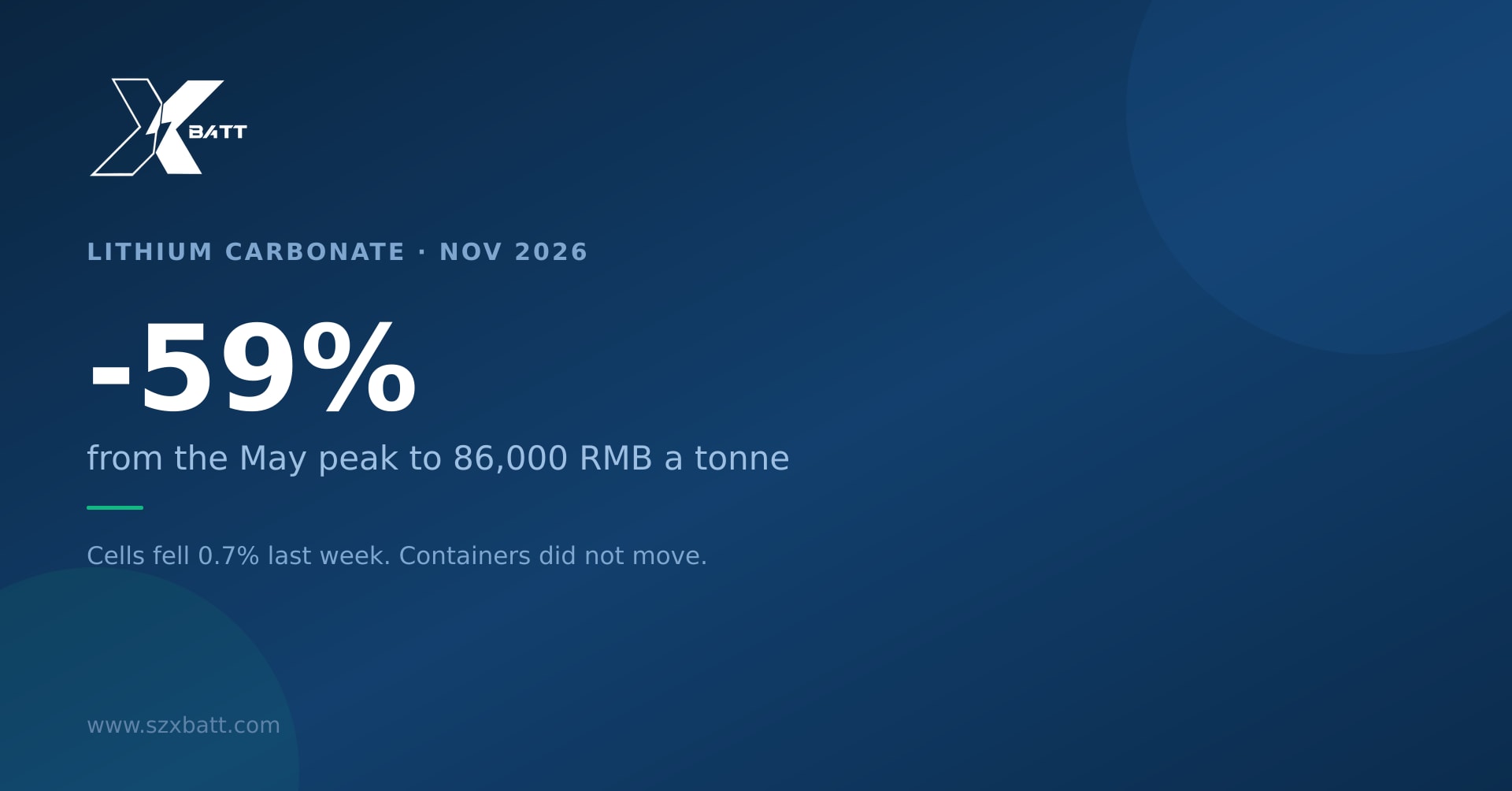
Battery-grade lithium carbonate peaked at 209,800 RMB per tonne in May. On 25 November it was quoted at 84,000–87,000, averaging 86,000 — down 2.8 % on the week, and about 59 % off the May high. Spodumene concentrate (SC6, CIF China) was 1,090 USD per tonne, down 4.4 % on the week.
Cells followed, but not one-for-one:
| Item, China domestic, tax included | 25 Nov 2026 | Range | Change on week |
|---|---|---|---|
| LFP storage cell, 100 Ah | 0.390 RMB/Wh | 0.370–0.410 | −2.5 % |
| LFP storage cell, 280 / 314 Ah | 0.343 RMB/Wh | 0.320–0.365 | −0.7 % |
| DC block, liquid-cooled, 2 h | 0.48 RMB/Wh | 0.44–0.52 | flat |
| AC block, liquid-cooled, 2 h | 0.58 RMB/Wh | 0.52–0.63 | flat |
| AC block, liquid-cooled, 4 h | 0.53 RMB/Wh | 0.50–0.55 | flat |
Notice the shape of that table. Lithium fell 2.8 % last week; the 314 Ah cell fell 0.7 %; the container did not move at all. The further you get from the mine, the slower the price moves — because between the carbonate and the container sit processing fees, anode and separator costs, a 2 % consumption tax that took effect on 1 September, and a queue at the cell factory.
And it did not start at the top. In the first half of 2026 the market went the other way: two-hour system bids averaged 599.3 RMB/kWh, up 8.3 % year on year, and four-hour systems 541.3 RMB/kWh, up 21.1 %, according to CNESA data cited in the Chinese trade press. Anyone who bought in March paid more than anyone who bought in January. That is the part people forget when they assume prices only fall.
Three things that set the floor
The ore cost. Spodumene at 1,090 USD/t converts to roughly 80,000–100,000 RMB per tonne of lithium carbonate equivalent, once you account for the 7–8 tonnes of concentrate per tonne of carbonate and processing. At 86,000, the marginal producer is close to break-even. That does not mean the price cannot go lower — it means it needs a reason, and "supply keeps arriving" is a weaker reason at 86,000 than it was at 200,000. This is the argument Chinese analysts make for a floor near here, and it is a reasonable one, though nobody should treat it as a guarantee.
Capacity versus demand. Planned Chinese storage cell capacity is around 2,000 GWh. Global storage demand for 2026 is forecast at roughly 936 GWh by one brokerage. Two times oversupply is real, and it is why the long-run trend is still down. But planned capacity is not operating capacity, and the gap between the two is where every price spike of the last three years was born.
The policy calendar. This one is specific to your order book. China's export-control suspension on lithium batteries runs to 10 January 2027. It has been extended twice and the direction of travel is toward tighter rules, not looser. If your 2027 volume depends on cells leaving China in the first quarter, the January date is a risk you should price, not a date you should discover in a shipping delay.
Why waiting is not free
Four costs move independently of the cell price, and all four have been moving against buyers this year.
Freight. Container rates on China–Europe and China–US lanes are not correlated with lithium. A 30 % swing in ocean freight on a 20-foot container of batteries is worth more per kWh than the last two months of cell deflation.
Currency. Your price is in dollars or euros; the cell is priced in RMB. If the RMB strengthens 3 % while the cell falls 2 %, you lose money by waiting. Nobody sends a press release about this one.
Tax. The 2 % consumption tax on lithium batteries has been in the price since September. It is not going away, and it applies on top of whatever the cell costs.
The slot. This is the one that actually hurts. Cell lines are booked in campaigns, not on demand. If you wait until February to place a Q2 order, you are competing with everyone else who waited, for capacity that was allocated in November. Lead time goes from six weeks to twelve, and the price you negotiate in a shortage is not the price on the index.
The clause that solves this
You cannot forecast lithium. You can write a contract that does not require you to.
The version I use with repeat distributors is a price band with a published reference: the base price is fixed, and it adjusts only if the reference (SMM battery-grade lithium carbonate monthly average, or the InfoLink cell index) moves outside a band of, say, ±8 % from the date of signature. Inside the band, nothing changes. Outside it, half the movement passes through, capped at ±15 % of the contract value.
Three things this achieves. It removes the "wait and see" standoff, because neither side is betting. It caps your downside if lithium spikes again the way it did in May. And it gives the factory a reason to hold your slot, because the price is no longer a one-way option in your favour.
Two more clauses worth arguing about now rather than in March:
- Delivery window before 10 January 2027, with the documentation responsibility named. If the suspension is not extended again, the paperwork burden lands on the exporter, and you want that sentence in the contract, not in an email.
- A pre-shipment capacity test on a sample string, with the protocol named (0.5 C, 25 °C, and a second run at your site's ambient if it is hot or cold). Cheaper than discovering a 5 % shortfall on arrival.
What I told him
Book 70 % of your 2027 volume now at a banded price, and leave 30 % open with a monthly call option. If lithium falls another 15 %, you buy the rest cheap and the 70 % is protected by the cap. If it rises, you are covered on most of your volume and you will be glad you did not wait for a bottom that nobody can identify until it is six months behind us.
He pushed back, reasonably: "But everyone says cells are going to 0.30."
Maybe. The 314 Ah cell at 0.343 with a range down to 0.320 is not far from it, and if capacity keeps arriving, 0.30 is plausible in 2027. But 0.30 in Q3 is not cheaper than 0.343 in Q1 if you cannot ship in Q1, and for a distributor the constraint is rarely the cell price — it is the customer who needs the container in April.
If you are working out how much of your volume to lock, the honest starting point is your actual energy requirement, not a target price. The sizing tool does that arithmetic, and if your mix includes lead-acid, the lead procurement note covers the other half of the same decision — lead and lithium have been moving in opposite directions this year, which is itself an argument for not putting all of a 2027 book on one metal.
The bottom is a date you recognise afterwards
Every buyer I have worked with who waited for the bottom ended up buying 8 % higher, three months later, in a hurry. Not because they were wrong about the direction, but because the bottom is only visible in the index, and by the time the index shows it, the cheap slots are gone.
The version of this decision that ages well is boring: split your volume, write a band, fix the delivery window, and stop reading lithium futures at midnight. The cell is 35 cents. Your attention is worth more than the two cents you are trying to save.
Sources
InfoLink Consulting, "Spot Price — Energy Storage," infolink-group.com, 25 Nov. 2026, https://www.infolink-group.com/spot-price-energy-storage/cn/.
CNESA DataLink figures for H1 2026 system bid averages, as reported in 储能世界, "碳酸锂从20.98万腰斩到8.9万," November 2026, http://mp.weixin.qq.com/s?__biz=MzE5MTM0NjM5MA==&mid=2247489794&idx=1&sn=c315c8bf11d442cc6e71a476a550f66c.
中信证券研究, "储能|降本增利,国内独立储能经济性拐点将至," 20 Nov. 2026, https://finance.sina.com.cn/wm/2026-11-20/doc-inizitcq4074165.shtml.
Ministry of Commerce and General Administration of Customs, Announcement No. 58 of 2026, 9 Nov. 2026, as summarised in the export-control note.
Looking for a reliable battery supplier?
Send us your requirements — model, quantity and target market. Quote within 24 hours.
Get a Quote