
Sodium-Ion Is Finally Real. Here Is Where It Still Loses to LFP.
A contractor in Kazakhstan sent me a photo of six swollen strings at minus thirty-five. Two quotes on his desk, and the sodium one was cheaper. That surprised me too.
The email said minus thirty-five
A telecom contractor in Kazakhstan sent me a photo in late October: a battery room, six strings of AGM, all of them swollen, and a thermometer on the wall reading minus thirty-five. Two winters, that was it. He had a quote in front of him for sodium-ion and another for LFP, and the sodium one was cheaper per kilowatt-hour, which he did not expect.
I did not expect it either, two years ago. So I went back through the numbers instead of answering him from memory, and the honest answer turned out to be more interesting than "sodium is the future" or "sodium is hype".
What actually changed this year
For most of the last five years sodium-ion was a conference battery: a sample in a glass case, a pilot line, a press release about a 1 MWh demonstration. That changed in 2026.
Shipments are the first number to look at. Global sodium-ion shipments were around 1 GWh in 2025. Estimates for 2026 land between 15 and 25 GWh, and stationary storage takes most of it. That is still small next to LFP — China alone shipped over 100 GWh of storage cells in the first half — but it is no longer a rounding error.
The second number is capacity. Planned sodium-ion manufacturing capacity for 2026 is about 273 GWh, almost all of it in China. Against 15–25 GWh of demand that is not a market, it is a land grab, and it tells you what the price will do over the next two years.
The third is product. CATL's Naxtra cell went into batch delivery in the third quarter: 300 Ah and up, a rated window of −40 °C to 70 °C, more than 15,000 cycles to 80 % state of health, and — this is the part that matters commercially — the same shell as its 587 Ah LFP cell, so packers and container makers do not have to redesign. In April a system integrator signed a three-year, 60 GWh framework for it. Sixty gigawatt-hours is roughly half of what that one manufacturer shipped in all of 2025.
So the question from Kazakhstan is now a real question, not a hypothetical one.
The price gap is sixteen dollars, and that is the whole story
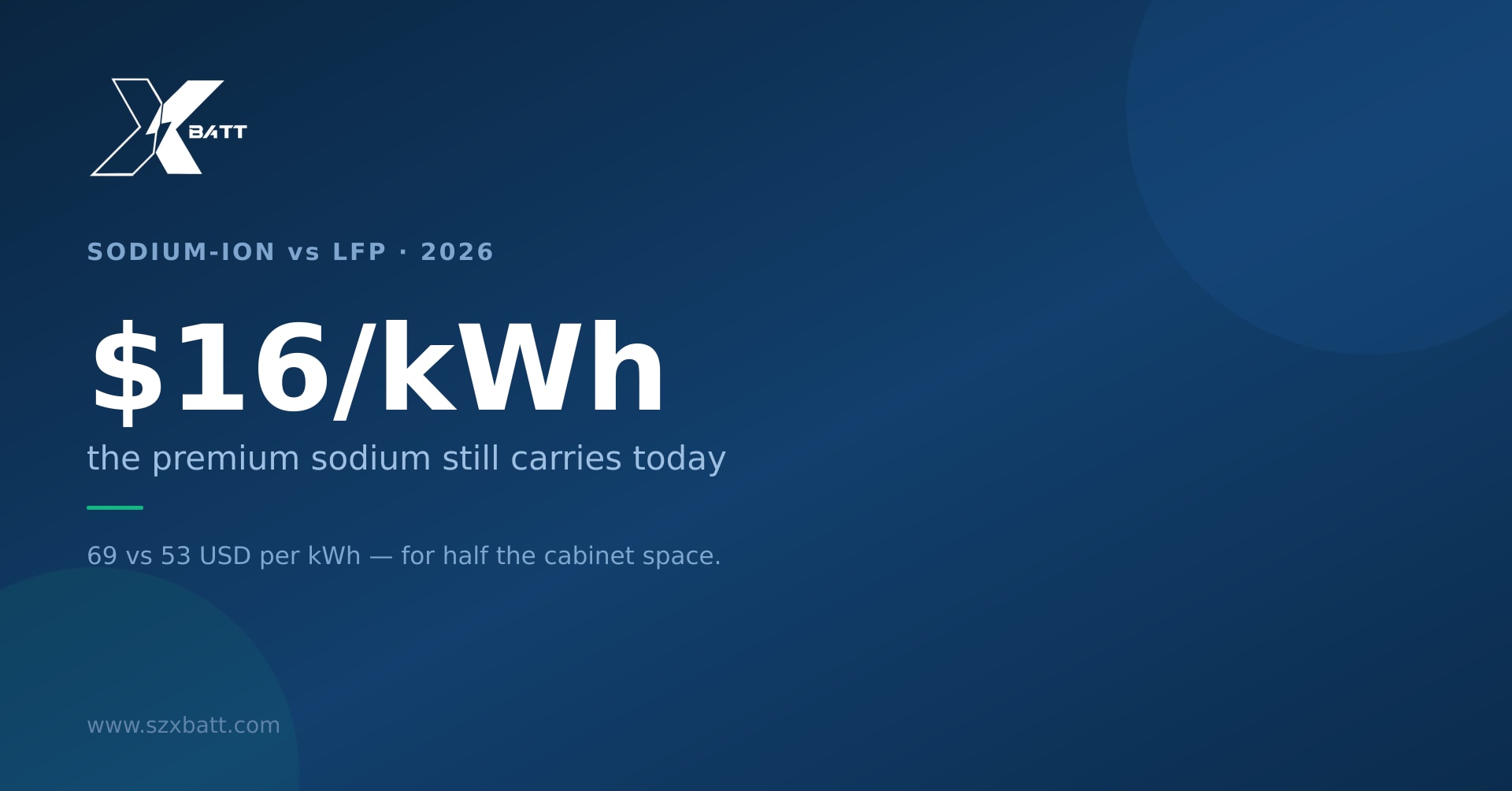
BloombergNEF puts 2026 sodium-ion cells at about 69 USD/kWh. Chinese LFP cells, same year, about 53 USD/kWh. Sixteen dollars, roughly 30 %.
For a 100 kWh telecom cabinet that is 1,600 dollars. For a 1 MWh commercial system it is 16,000 dollars, which is real money but not the kind of gap that decides a project on its own — freight, duties and installation can move a landed cost by more than that.
And the direction matters more than the level. Sodium's premium has been narrowing all year as capacity comes online and hard-carbon anode supply loosens. Nobody credible will tell you the exact quarter it crosses zero. Several will tell you it crosses.
One caution before you multiply anything: 69 dollars is a cell price. The system price gap is wider, because sodium systems today have fewer mature enclosure, thermal and BMS platforms behind them, and integrators price unfamiliarity in.
Where sodium genuinely wins
I sell LFP and lead-acid, so treat the next few paragraphs with the suspicion they deserve. I will still tell you where sodium is the better cell, because pretending otherwise wastes your money and my credibility.
Cold. This is the strongest case and it is not close. Sodium chemistry keeps a usable share of its capacity at −20 °C and below, and it does not need the heating pad and the charge-suppression logic that an LFP pack needs in a cold room. In a telecom hut in Inner Mongolia or a security cabinet in northern Sweden, that heating load is not a detail — it is a permanent parasitic drain on a system that is already sized tight. If your site spends weeks below zero, sodium deserves a serious look.
Cycle count at high frequency. Fifteen thousand cycles at 80 % state of health is roughly double a good LFP storage cell. On a duty that cycles twice a day, that is the difference between replacing the pack once in twenty years and not replacing it at all. It also means the warranty conversation changes from "how many years" to "how many megawatt-hours throughput", which is the right unit anyway.
Thermal tolerance and safety optics. Sodium cells are less energetic per kilogram, which paradoxically helps: thermal runaway is easier to contain, transport classification is friendlier, and the fire-separation argument in a permit application gets shorter. I have watched a lithium container add six figures to a project in separation distances alone. That is a sodium advantage no datasheet line item captures.
No lithium price exposure. This one is strategic rather than technical. If your five-year business case assumes a commodity you do not control, sodium removes that variable. Whether that is worth 16 dollars a kilowatt-hour is a treasury question, not an engineering one.
Where it still loses, and this is why most quotes stay LFP
Volume. Sodium cells carry around 160 Wh/kg and somewhere near half the volumetric energy density of LFP. Twice the cabinet for the same megawatt-hour. If your constraint is a 19-inch rack in a shelter, a wall in a plant room or a container slot on a ship, that is not a footnote, it is the design.
Efficiency at the system level. Cell-level claims are not system-level numbers. Ask for measured DC round-trip efficiency at your duty cycle and your temperature, from a unit that has run for six months, not a platform figure from a launch event.
Ecosystem. Certification, spare cells, BMS firmware maturity, the technician who has seen one before. LFP has fifteen years of field failure data and a supply chain that can air-freight a replacement board in a week. Sodium has a very good 2026 and not much of a 2019.
Resale and financing. Banks and insurers have models for LFP. They are still building models for sodium, and a technology that a lender discounts is a technology that costs you more than the quote says.
The four cases, decided
| Your site | What I would quote | Why |
|---|---|---|
| Telecom hut, −20 °C winters, 4–8 h backup | Sodium, if the rack fits | Heating load disappears; 15,000 cycles covers 20 years of shallow duty |
| C&I storage, daily cycling, temperate climate | LFP | Cheapest per usable kWh today; mature BMS and service network |
| Long-duration grid or industrial, 6–10 h | LFP for now, revisit in 2028 | Volume and capex dominate; sodium's density penalty hurts at scale |
| Remote security or RTU site, small load, no maintenance visits | Sodium or a flooded tubular bank | Both tolerate abuse; sodium avoids watering, lead wins on price per watt-hour |
Note what is not in that table: "sodium is better". There is no such line. There is only a site.
Four questions to ask any sodium quote
If you are going to spend the premium, spend it on evidence.
- Cycle life at what depth, on which test method, at what temperature? "15,000 cycles" means nothing without the DoD and the protocol. Ask for the report, not the brochure.
- DC round-trip efficiency measured on a delivered unit at 0 °C and at 35 °C. A single number at 25 °C is marketing.
- Litres per megawatt-hour and floor loading in kg/m². Compare against the LFP option on the same drawing. This is where the 16 dollars often comes back.
- Who honours the warranty in your country, and where do spare cells come from? A ten-year warranty from an entity that did not exist three years ago is a promise, not an asset.
What I told him
I told him to take the sodium quote, and then to send it back with those four numbers filled in, and to compare it against a flooded tubular bank as well — because at −35 °C with four hours of standby duty, a well-specified OPzS string is still a defensible answer, and it costs a fraction of both.
He came back two weeks later with LFP. Not because sodium lost on chemistry, but because the rack was 600 mm deep and the sodium cabinet was not. That is how most of these decisions actually get made: not by the chemistry that wins the headline, but by the one that fits the room. If you are sizing that room right now, the battery sizing tool will tell you how much energy you actually need, and the cold-weather charging note covers what happens to LFP below zero — which is the number that decides whether you need sodium at all.
Sources
BloombergNEF, via 电池中国网, "2026年钠离子电池展望:发展势头增强," batterychn.com, 2026, https://www.batterychn.com/newinfo-1447-2.
InfoLink Consulting, "现货价格 — 储能," infolink-group.com, 25 Nov. 2026, https://www.infolink-group.com/spot-price-energy-storage/cn/.
集邦咨询 / TrendForce, sodium-ion cell specifications and delivery schedule summary, via 三个皮匠报告, 2026, https://www.sgpjbg.com/searchtag/27453078.html.
常衡德宇, "钠电叫板磷酸铁锂:大规模储能,到底该选谁?," cn-deman.com, 2026, https://cn-deman.com/cn/news2_show?id=75.
Looking for a reliable battery supplier?
Send us your requirements — model, quantity and target market. Quote within 24 hours.
Get a Quote