
Storage Is Moving to Four Hours. The Spec Sheet Hasn't Caught Up.
A four-hour battery is not a two-hour battery with more racks. Once the hours change, the thing you are buying changes — and so does the chemistry that wins.
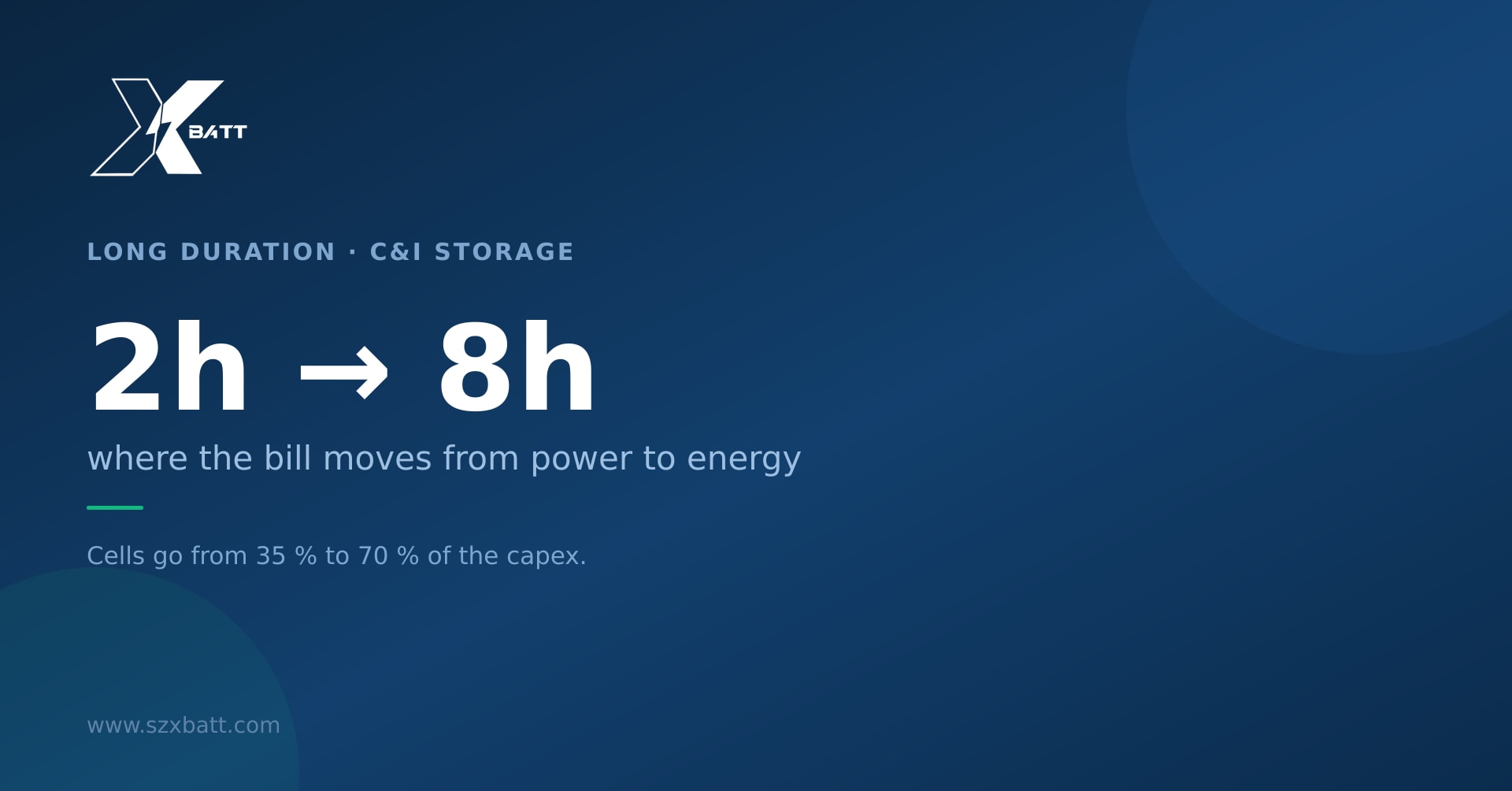
The tender said four hours. The quote looked like two.
A project engineer sent me a comparison sheet last week. Two bidders, same 20 MWh, same site, and one quote came in at 78 % of the other. He wanted to know which one was cheating.
Neither, probably. One had priced a four-hour system by taking a two-hour design and doubling the racks. That works on paper and fails on the site, because a four-hour battery is not a two-hour battery with more of it. When duration changes, the thing you are buying changes.
Let me make that concrete, because it is the whole argument.
Two hours is a power product. Eight hours is an energy product.
At two hours, roughly a third of your capital sits in the inverter and transformer, a third in cells, and the rest in the container, thermal and controls. You are buying a machine that can move a lot of power quickly, and the energy is almost a by-product. This is why a two-hour quote is so sensitive to PCS pricing and so insensitive to cell chemistry.
At eight hours, the cells are 70 % or more of the bill, the PCS is a rounding error, and suddenly every watt-hour of loss, every degree of thermal load and every square metre of land matters. You are no longer buying a power machine. You are buying a warehouse with a door.
The industry has spent five years optimising the power machine. The move to four, six and eight hours drags the conversation back to the boring part: how much energy, at what cost, in how much space, for how many cycles.
The policy number that made everyone look up
On 13 November, the National Development and Reform Commission and the National Energy Administration issued the 15th Five-Year Plan for new-type energy storage. The headline target: 300 GW by 2030, at an average duration of about three hours.
Read that second half again. Not 300 GW of batteries — 300 GW averaging three hours, which is roughly 900 GWh of energy capacity. The two-hour frame that most tenders have used for the last five years is being replaced by something longer, and the plan says so in a single clause that most coverage skipped.
The hardware is already moving. One of the large Chinese cell makers launched an eight-hour product in early November: 6.9 MW / 55.2 MWh in a single unit, built around a 1,300 Ah cell. Regardless of what you think of the vendor, the direction is unambiguous — bigger cells, longer stacks, fewer containers per MWh. That last one sounds like good news until you remember that transport weight, floor loading and fire separation all get harder as energy density per container goes up.
Where lead-acid actually walks back in
Here I have to be careful, because the lazy version of this article would say "longer duration means lead-acid wins again" and that is not true in 2026.
Lithium iron phosphate has spent three years falling in price. At the system level, an LFP cabinet today costs less per installed kilowatt-hour than a flooded OPzS bank. If your only number is capex per kWh, lead-acid loses, and it loses clearly. I am not going to pretend otherwise.
But capex per kWh is the wrong number for a long-duration site, and here is why. What you actually pay for is kWh moved per dollar of lifetime cost, and that changes with duty:
- Daily cycling, 300+ cycles a year. LFP wins outright. Higher round-trip efficiency, no watering, no equalise charge, and the cycle count at 80 % depth is simply in a different league. Lead-acid's cost per kWh throughput is three to five times higher and no amount of capex arithmetic fixes it.
- One cycle a day or fewer, and a hot plant room. Now the comparison changes. A flooded OPzS bank at a 20-year design life has no BMS to fail, no coolant loop, no cell-level electronics that will be obsolete before the battery is, and it tolerates 35 °C ambient that would send a lithium container into derating. It also does not need the fire separation distances that a lithium container triggers in most jurisdictions.
- Standby that happens to be measured in hours. Eight hours of backup for a hospital, a water plant, a semiconductor line — this is lead-acid's home ground, and it always has been. High energy, low throughput, decades of float. Nobody should be putting a daily-cycling lithium asset there and paying for cycle life they will never use.
So the honest version is: longer duration makes the energy part of the bill dominate, which favours whatever is cheapest per usable kWh at your cycle count. For a daily-cycled grid asset that is LFP. For a low-throughput, long-hold, hot or remote site, that is still very often a flooded tubular bank.
| What dominates | 2 hours | 4 hours | 8 hours |
|---|---|---|---|
| PCS + transformer | ~30–35 % | ~15–20 % | ~8–10 % |
| Cells / jars | ~35–40 % | ~55–60 % | ~65–72 % |
| Thermal + enclosure | ~12 % | ~15 % | ~15–18 % |
| Site works, protection, fire | ~10 % | ~12 % | ~12 % |
Six numbers I would demand on a long-duration quote
Most quote sheets are built to be compared, not to be understood. These six are the ones that decide whether the number is real.
- Usable kWh at the depth of discharge you will actually run — and at end of life. A 20 MWh nameplate that is 90 % usable when new is 16 MWh at 80 % state of health in year twelve. If the quote does not say "at end of life", it is quoting a battery that does not exist yet.
- DC round-trip efficiency at the real duty. LFP sits around 88–92 %. A flooded bank is nearer 75–85 % once you count the charge factor. Over eight hours and 300 cycles a year, four points of efficiency is a lot of megawatt-hours — and it is invisible on the capex line.
- Auxiliary load as a percentage of throughput. A lithium container spends 3–8 % of what it stores on cooling. A lead-acid room spends less on cooling but needs ventilation, and the fans are not free. Ask for the annual figure in MWh, not a percentage of "typical".
- Cycle count at your DoD, with the test method named. 6,000 cycles at 90 % DoD and 6,000 cycles at 60 % DoD are different products. For lead-acid, the cycle claim has a test method behind it and IEC 61427 is the one that applies to renewable-energy duty — not the automotive standard that gets quoted in brochures.
- Square metres per MWh, and floor loading in kg/m². Lead is roughly two and a half times the mass per kilowatt-hour of LFP. On a mezzanine or a retrofitted plant room, that is not a datasheet detail, it is a structural question, and it gets answered by a civil engineer at your cost.
- Fire separation and what the authority will ask for. A lithium container usually needs separation distances, detection and suppression sized to the code in force. A flooded battery room needs ventilation, spill containment and eyewash. Both are legitimate; only one of them gets discovered late, and it is usually the container.
The mistake that costs the most
Sizing by nameplate. It happens on every project and it is worse on long duration, because the error is multiplied by hours.
A tender that says "20 MWh" and means "20 MWh usable at end of life, at 25 °C, at 0.5 C" is a completely different procurement from one that says "20 MWh" and means "the sum of the cell labels". At two hours the gap is absorbed by oversizing the PCS and nobody notices. At eight hours the gap is the project.
The same logic explains why so many long-duration designs quietly end up with a shorter effective duration in year five: efficiency falls, auxiliary load rises, and the usable window shrinks while the nameplate on the door still reads 20 MWh.
If you are rewriting a specification for a C&I or industrial site rather than a grid asset, the arithmetic is smaller but the questions are identical — the industrial storage page walks through the cycle-count-first version of this, and tubular versus flat plate is the same argument one level down, at the plate.
Duration is a site decision before it is a chemistry decision
The plan says three hours average by 2030. The vendors are shipping eight. Your site will be somewhere in between, and the number that decides it is not in either document — it is how many times a year you intend to move energy, and how hot the room gets in July.
Get those two answers first and the chemistry almost picks itself. Get them last, and you will spend the next decade explaining why an asset designed for 300 cycles a year is being run at 600.
Looking for a reliable battery supplier?
Send us your requirements — model, quantity and target market. Quote within 24 hours.
Get a Quote