
Q1 2027 Has Three Deadlines, and They Collide
A buyer asked if he could just push everything to March. Then I put the three dates on one line: the suspension, the holiday, the passport. Forty-five days apart.
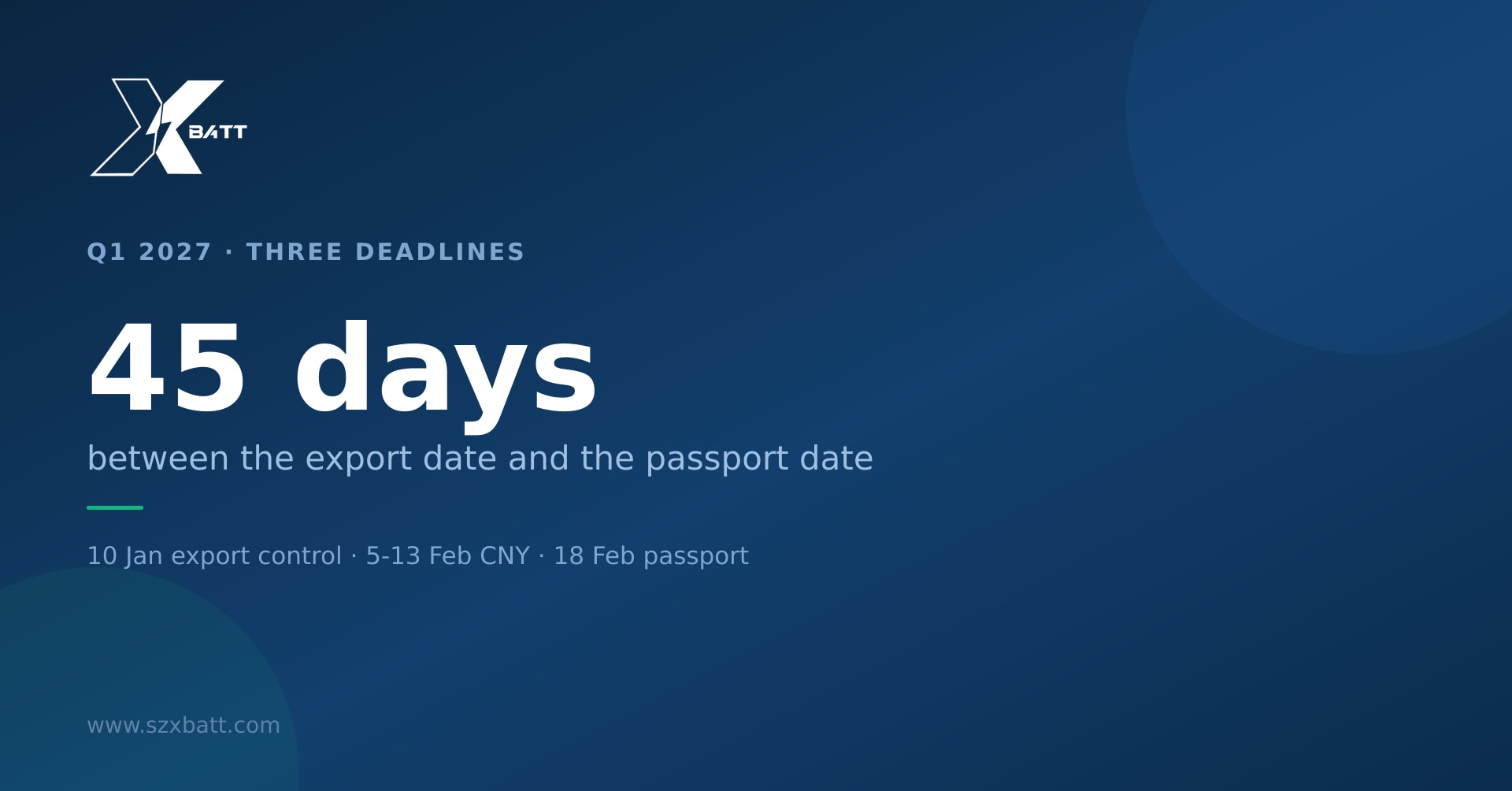
Three dates, and they are not spread out
A buyer in the Netherlands asked me last week whether he could "just push everything to March". He had heard about Chinese New Year and wanted to avoid the crunch. Fair enough. But when I put the three dates on one line, he went quiet:
- 10 January 2027 — the Chinese export-control suspension on lithium batteries expires, unless it is extended a third time.
- 5–13 February 2027 — the official Spring Festival holiday. New Year's Day itself is Saturday 6 February.
- 18 February 2027 — the EU battery passport becomes mandatory for industrial batteries above 2 kWh.
Forty-five days between the first and the last. Pushing to March does not avoid that window. It lands you in the middle of it.
Why February is the trap, not January
Here is the part that catches people: the passport applies when the battery is placed on the EU market, not when it was made.
So a container that leaves Ningbo on 20 January, produced while the factory was still open and perfectly compliant with the rules in force at the time, arrives in Rotterdam around 1 March — and the batteries inside it are being placed on the market after 18 February. The importer needs a passport for them. The production date is irrelevant; the release into free circulation is the trigger.
That single sentence turns a shipping schedule into a compliance deadline. Every unit in that container needs its record before it clears, and the data has to come from you, the factory, because the importer cannot invent your cell chemistry.
If you want to be on the right side of that line without a passport, the cargo has to arrive before 18 February. From Shanghai or Ningbo to Rotterdam is roughly 30–35 days port to port, plus 5–10 days for customs and delivery. Work backwards and the sailing you need is the one leaving in the first week of January. Which is exactly the week the export-control suspension expires.
The date nobody can give you
Chinese New Year 2027 falls on Saturday 6 February, eleven days earlier than 2026. The State Council notice, issued on 5 November 2026, sets the public holiday from Friday 5 February to Saturday 13 February — nine days — with Sunday 31 January and Sunday 14 February as make-up workdays.
That is the official calendar. It is not the factory calendar.
In practice, production winds down about a week before the holiday and does not come back to full speed for two to three weeks after it. Migrant workers leave early to beat the transport crush, and a meaningful share do not return to the same line — 20 to 30 % turnover after the break is normal. Lines restart at half crew, quality drifts for the first batches, and the backlog from January takes weeks to clear.
So the realistic picture is: last full production week around 18–22 January, output tapering to nothing by the 30th, near-zero capacity until 20 February, and 60–80 % capacity through the first half of March.
The three windows, and what to do in each
| Window | What is happening | What you should have done |
|---|---|---|
| Now – 10 Dec | Factories are still running at full speed; cell and container slots are being allocated | Place Q1 purchase orders, confirm production slots in writing |
| 10 – 31 Dec | Pre-holiday rush; ocean space tightens, rates firm, equipment gets scarce | Book space, submit shipping documents, finish the passport data pack |
| 1 – 24 Jan | Last production and last sailings; anything late slips past the holiday | Get cargo to port by 10–15 Jan at the latest |
| 25 Jan – 20 Feb | Production stopped; ports and trucking on reduced staffing | Nothing moves. Do not plan a shipment here |
| 21 Feb – mid Mar | Restart and ramp; quality risk on first batches | Schedule pre-shipment inspection, expect slippage |
The window that looks safe and is not: 1–20 February. Ships still sail, ports still work at reduced capacity, and a booking made in that gap will either roll or arrive after the passport deadline with no data behind it.
What this means for lead-acid versus lithium
The two product lines fail differently in this period, and it is worth planning them separately.
Lead-acid is heavy and cheap per kilogram, so it goes by sea, and it is booked on weight and volume. The constraint is container availability in the last week of January, not production. A flooded OPzS bank is also the product most likely to be below 2 kWh per unit, which means no passport — but the QR code requirement still lands on 18 February, and that is a labelling change you can implement in December rather than a data project.
Lithium has a longer chain: cells are allocated in campaigns, packs are assembled after cells arrive, and the dangerous-goods documentation — UN 38.3 test summary, MSDS, transport declaration — has to be ready before the forwarder will even quote. If your cells land in January and your packs are assembled in the first week of February, you have built a shipment that cannot legally enter the EU without a passport. The shipping file covers the dangerous-goods side; this is the calendar side.
One more thing on the export-control date. The suspension has been extended twice, and the pattern suggests a third extension is plausible. Plausible is not the same as certain, and the cost of being wrong is a container held at the port while a licence question is resolved. If your January shipment includes cells anywhere near the 300 Wh/kg line, the sensible move is to ship before 10 January rather than bet on an announcement. If your cells are 280 Ah LFP at around 170 Wh/kg, the control list never covered you — but the forwarder will still ask, and having the answer in writing saves a week.
What I would put in the purchase order
Four lines, none of them dramatic, all of them cheap to write now and expensive to argue about in February.
- Latest cargo-ready date, not just a delivery date. "Cargo ready at Ningbo by 10 January 2027" is enforceable; "delivery in Q1" is a conversation.
- A named vessel or a named week, with the rolling consequence stated. If the booking rolls, who pays the storage, and does the price hold?
- Passport data delivery date, 30 days before shipment. This forces the data pack to exist in December, when the factory is still answering emails, instead of on 17 February.
- A clause on the 10 January date. Something like: if the export-control suspension is not extended and the shipment requires a licence, either party may reschedule without penalty. That is a fair clause and it costs nothing to agree in November.
The version of this that goes wrong
Every year the same thing happens to somebody: they plan around the holiday, book for late January, the booking rolls to 8 February, the factory is closed so nothing can be reworked, the vessel arrives on 5 March, and the container sits at Rotterdam because the passport data was never collected.
The fix is not clever. It is December: place the order, book the space, collect the data, and get the cargo to the port before the second week of January. Everything after that is weather and luck.
If you are working out how much to ship before the window closes, start from the energy you actually need rather than the container you usually book — the sizing tool does that arithmetic in a couple of minutes. And if your Q1 includes EU-bound storage cabinets, read what the passport actually requires before you confirm the sailing, because the answer changes which units can travel in February and which cannot.
Sources
General Office of the State Council of China, 2027 public holiday arrangement, notice issued 5 Nov. 2026, as reported in ch-shipping.com, "Chinese New Year 2027: Factory Shutdown, Cut-Offs & How to Ship," 2026, https://ch-shipping.com/blog/chinese-new-year-2027-shipping-factory-shutdown.
UnionCargo, "2027年春节:从中国订货最晚何时下单,才能赶在假期前发货," 2026, https://unioncargo.pl/zh/blog/2027%E5%B9%B4%E6%98%A5%E8%8A%82.
MING Sourcing, "農曆新年採購指南:CNY如何影響您的供應鏈," 2026, https://www.mingsourcing.com/zh-hant/blog/chinese-new-year-sourcing-guide.html.
Ministry of Commerce and General Administration of Customs of China, Announcement No. 58 of 2026, 9 Nov. 2026, summarised in the export-control note.
European Commission, Regulation (EU) 2023/1542, Art. 77, https://eur-lex.europa.eu/eli/reg/2023/1542/oj.
Looking for a reliable battery supplier?
Send us your requirements — model, quantity and target market. Quote within 24 hours.
Get a Quote