
Six Months in the Warehouse Is Half a Warranty
Four pallets sat in a Rotterdam warehouse from spring to September. The first string ran nine hours instead of twelve, and nothing was wrong with the batteries.
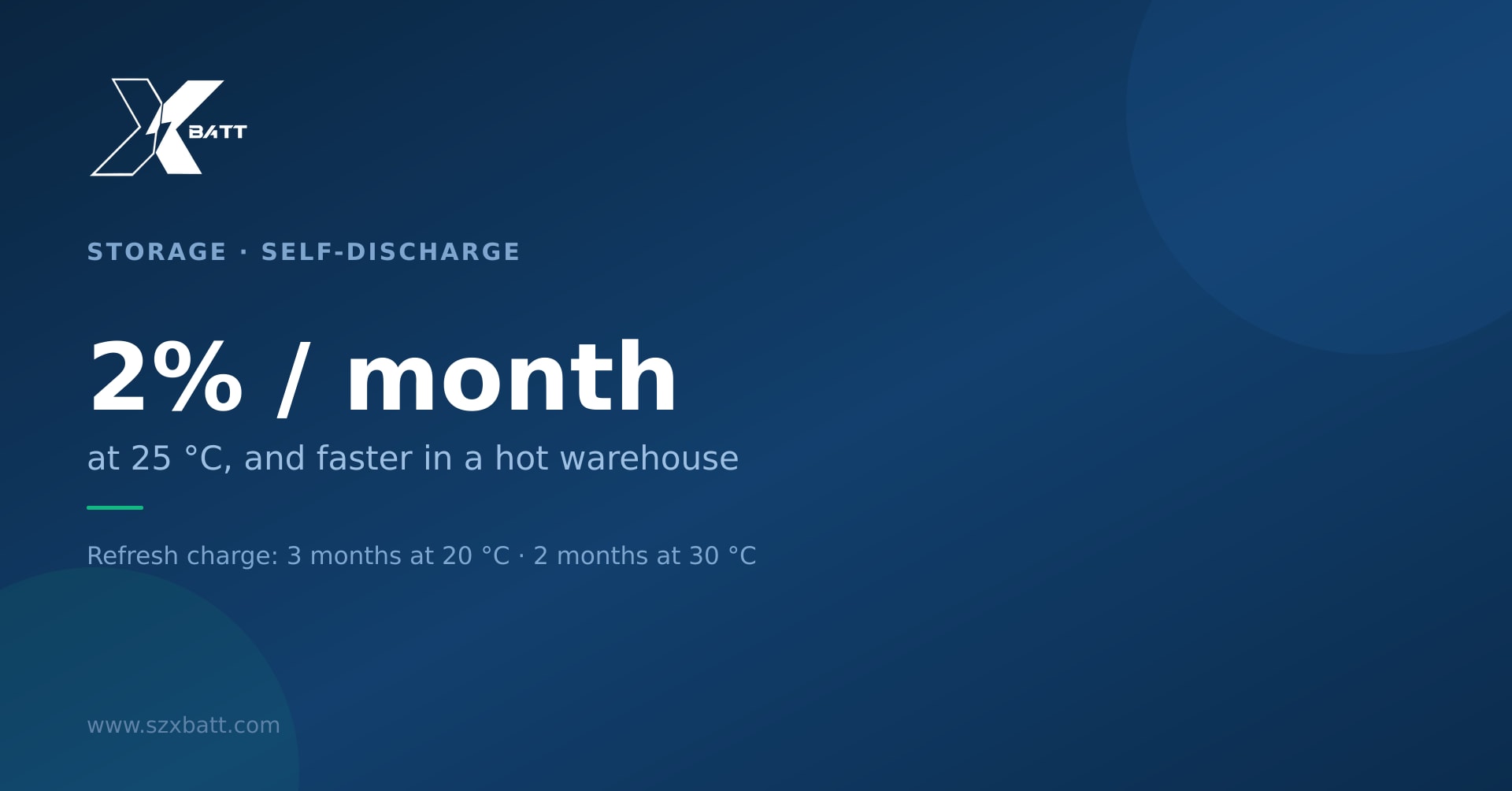
The pallet that waited five months
A customer in Rotterdam ordered four pallets of 12V 150Ah AGM in spring, sold two, and forgot the rest until September. When the installers finally put them in, the first string ran for nine hours instead of the rated backup window. He called me: "These are new batteries. What happened?"
Nothing happened. That is the problem. A lead-acid battery on a pallet is not asleep — it is very slowly discharging itself, and the warmer the warehouse, the faster it goes. Five months of doing nothing can cost more capacity than a year of light service.
Self-discharge is not a defect, it is chemistry
Every lead-acid block loses charge on its own, even with nothing connected. At 25 °C a healthy VRLA loses about 2% of its charge a month; some suppliers quote 3–5% for thinner plates or warmer stores. That sounds harmless until you do the arithmetic on a slow-moving SKU.
The number that matters is not the monthly percentage, it is where the battery ends up. Below roughly 50% state of charge, lead sulphate starts to harden into crystals that ordinary charging cannot break down. That is sulphation, and it is permanent. So the question is never "how long can it sit" but "how long before it drops below half".
Most manufacturers publish a shelf-life table, and they are all variations of the same physics: the permitted storage time roughly halves for every 10 °C, just like service life.
| Storage temperature | Time before a refresh charge |
|---|---|
| 10 °C | up to 6 months |
| 20 °C | up to 3 months |
| 30 °C | up to 2 months |
A warehouse in Lagos and a warehouse in Rotterdam are not the same warehouse. If your stock sits under a metal roof in summer, plan for the 30 °C column, not the 20 °C one.
The check takes ninety seconds per pallet
You do not need a battery analyser to know whether stock is drifting. You need a multimeter and a habit.
Measure open-circuit voltage on a sample of blocks — five per pallet is enough if they arrived together — after the pallet has rested a few hours, not straight off a charger. A 12V block at 12.7 V is full. At 12.45 V it is around three-quarters. At 12.2 V it is about half, and that is the line where you should be charging, not measuring.
| OCV (12V block) | Approximate state of charge |
|---|---|
| 12.70 V | 100% |
| 12.45 V | 75% |
| 12.20 V | 50% |
| 11.95 V | 25% |
| below 11.80 V | effectively flat — assume damage |
Whatever the percentage, act on the trend, not the single reading. Two measurements three weeks apart tell you the real self-discharge rate of your store, including the effect of that skylight nobody thought about.
Write the date on the pallet in marker. It sounds crude. It is also the only method that survives staff turnover.
Charging stock is not the same as charging a battery in service
A refresh charge is not a full cycle. You are topping up, not cycling. Constant-voltage at the manufacturer's float setting — 13.5–13.8 V for a 12V VRLA at 25 °C — until the current has dropped and stayed low, typically 12–24 hours for a pallet-sized bank if you charge in parallel. Charging at 14.4 V "to be sure" is how you dry out a sealed battery that was perfectly fine.
Two practical rules:
- Never stack a refresh charge on a hot battery. Let it come down to room temperature first; charging a 40 °C block at 25 °C voltage settings is overcharging it.
- Never leave a pallet on charge indefinitely "just in case". A sealed battery on permanent float in a warehouse is ageing every day, and nobody is logging it.
If you store lithium, the rules change. LiFePO4 does not sulphate, and it self-discharges more slowly, but it dislikes sitting at 100% in a hot room. Most cell makers ship at 30–50% state of charge for a reason; keep it there for long storage, and top up every six months. The failure mode you are avoiding is not sulphation but calendar ageing at high SoC and high temperature — the same 10 °C logic, different chemistry.
I wrote about the cold end of this separately, because winter storage has its own trap: a frozen battery is not a dead battery, but a frozen battery that gets charged is. That piece is here.
FIFO is a warranty instrument, not warehouse tidiness
Here is the part that costs money quietly. On most lead-acid warranties, the clock starts at the invoice or the bill of lading, not at installation. A pallet that sits six months in your warehouse has already spent a quarter of a 24-month warranty before a customer sees it, and it has also lost charge. You are selling a shorter warranty on a weaker battery at the same price.
First-in, first-out is the cheapest fix in the whole chain. It costs nothing except discipline: oldest pallet ships first, date written on the carton, and a monthly voltage check on whatever is left. If a SKU does not move, discount it or stop reordering it — sitting on it is not free.
What to put in the warehouse SOP
One page, four lines, and the argument is over:
- Store indoors, 15–25 °C, off the floor, out of direct sun.
- Mark the arrival date on every pallet. Ship oldest first.
- Check OCV on five blocks per pallet every month. Below 12.4 V, charge.
- Refresh charge every 3 months at 20–25 °C, every 2 months above 30 °C — at float voltage, not at 14.4 V.
If the stock is already older than the table allows, do not panic and do not ship it quietly. Charge it, let it rest, measure again, and run a capacity test on one block before the container leaves. A block that recovers to 95% is sellable. One that sits at 70% is a claim waiting for a port. We wrote about telling new stock from refurbished here, and the same discharge test settles both questions.
The Rotterdam pallets probably recovered most of their capacity after a proper charge. Not all of it — five months at whatever that warehouse reaches in July leaves a mark. The next order went out with a date written on every carton, which is a small thing until you have to explain to a customer why his "new" battery only ran nine hours.
Sources
Discover Battery, "How to store VRLA batteries," technical note, accessed 27 Nov. 2026, http://www.discoverbatterys.com/newsdetail_3172387.html.
Sebang Battery, "How to store valve-regulated lead-acid batteries," technical note, 12 June 2023, http://www.orzxyx.com/news/303.html.
Industrial Monitor Direct, "Lead-acid battery storage maintenance: engineering protocol for stored equipment," knowledge base, accessed 27 Nov. 2026, https://industrialmonitordirect.com/zh-hant/blogs/knowledgebase/lead-acid-battery-storage-maintenance-engineering-protocol-for-stored-equipment.
Dingwei Battery, "Battery storage and shelf life," knowledge note, accessed 27 Nov. 2026, https://dingweibattery.com/knowledge/battery-storage-shelf-life.
Looking for a reliable battery supplier?
Send us your requirements — model, quantity and target market. Quote within 24 hours.
Get a Quote